Enhancing Security With ACH Positive Pay For Businesses
Protect your business from unauthorized ACH debits by learning how ACH positive pay works and how to set it up.


Key takeaways
- Approve your regular payers in advance so ACH positive pay can flag and hold any debit that does not match your list.
- Compare ACH positive pay with an ACH debit block, and use them together when an account should rarely be debited.
- Budget about $20 to $50 per month for the service, far less than recovering funds from a single fraudulent debit.
- Review flagged payments daily and set a smart default decision so nothing clears without your approval.
What is ACH positive pay?
ACH positive pay is a bank fraud-control service that checks incoming ACH debits against your list of approved payers before they clear. It stops unauthorized or unexpected debits from posting to your account.
It builds on ACH payments, the Automated Clearing House network that moves money electronically between banks. Funds move through financial institutions that clear the bank-to-bank transactions.
ACH positive pay is a function that helps ensure the safest ACH payments and reduce the risk of fraud and unauthorized debits to your account. With positive pay, the business creates a list of vendors that they regularly pay. ACH payments to these approved vendors occur automatically. If a transaction occurs for a non-listed vendor, then the ACH positive pay system will send an alert and request authorization from the business to approve the payment.
Businesses can define positive pay settings to flag certain payments or to put a cap on the amount paid. This provides an added layer of security so that the chance of unexpected or incorrect payments is reduced.
ACH and check positive pay are based on a similar concept. Most commercial banks use positive pay for checks to prevent check fraud. Here’s how it works:
- Businesses provide their bank with a list of information about checks they issued and intended to be cleared from the account, including check number, date, amount, and bank account number.
- Before depositing the checks, the bank cross-checks each and compares it to the list.
- The checks that match up are cleared for deposit.
- Checks that have discrepancies or are not on the list are set aside, and the bank follows up with the business to verify the payment.
What is reverse positive pay?
Reverse positive pay is a variation of positive pay that puts the responsibility for verifying payments on the business. Instead of the bank doing the work of cross-checking payments according to the approved list, in reverse positive pay, the business checks the transactions according to a list of pending payments provided by the bank. Payments that are approved by the business are authorized and completed, while payments that are not approved go on hold until further investigation or rejection.
How ACH positive pay works
Now that we’ve covered the definitions of ACH positive pay, check positive pay, and reverse positive pay, let’s drill down into the step-by-step explanation of how ACH positive pay works:
- Set up and authorization: The business signs up to the ACH positive pay service via its bank. During the setup process, the business specifies its approved vendor list and other criteria for authorized transactions, including amount limits.
- Incoming ACH payments: ACH payments are presented to the bank. The bank compares each transaction against the pre-approved list provided by the business.
- Matching transactions: The positive pay system checks the details of each incoming ACH payment against the authorization list. If a transaction matches the pre-approved list, it is automatically processed and paid.
- Flagging unmatched payments: ACH payments that do not match up with the pre-approved list of vendors or payments are flagged, and the system alerts the business. Then, further investigation can determine whether to accept or reject the payment.
ACH positive pay vs. ACH debit block
ACH positive pay and ACH debit blocks both help stop unwanted debits, but they work differently. ACH positive pay reviews each incoming debit against your list of approved payers and flags anything that does not match, so you decide whether to pay or return it.
An ACH debit block is more of an on-off switch. It stops all ACH debits from hitting an account, or limits them to a short list of approved payers, without the same payment-by-payment review.
Positive pay gives you finer control and a clear record of decisions. A debit block is simpler and works well for accounts that should rarely, if ever, be debited. Many businesses use the two together.
Benefits of using ACH positive pay
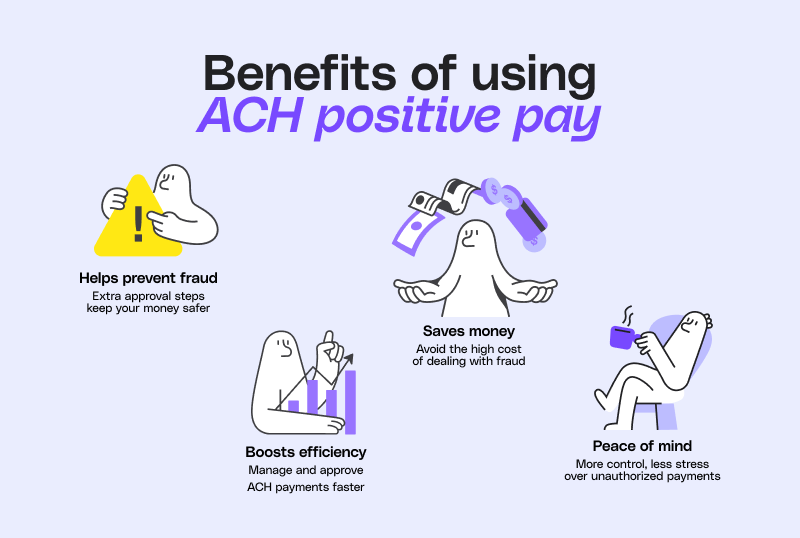
ACH positive pay is a mostly automated process that enables businesses to maintain tighter control over payments and reduce the risk of unauthorized ACH transactions, without adding a lot of extra work to your plate. Let’s explore some specific benefits that come with ACH positive pay:
Fraud prevention and security benefits
Fraud prevention is the core benefit. Pre-approving payers and amounts adds a validation layer that blocks unauthorized debits before they post, which is what makes ACH security stronger with positive pay in place.
Cost savings compared to handling fraudulent transactions
Dealing with fraudulent payments is very expensive, far more than preventing them in the first place. Many banks charge a monthly fee for ACH positive pay, commonly from about $20 to $50 per account, sometimes with a small per-filter fee. This is a much cheaper alternative compared to handling fraudulent transactions, and could save your business significant costs in the long run.
Increased efficiency in managing ACH payments
ACH payments are faster and more convenient than checks sent by snail mail, and cheaper than credit card fees. With ACH positive pay, transactions are pre-approved by the business, enhancing not just security but efficiency as well. Businesses can manage payments and receive money quicker, knowing that their ACH transactions, including same day ACH, are safe. This means peace of mind for business owners and financial managers.
Implementing ACH positive pay
How can businesses implement ACH positive pay and get all the ACH advantages while ensuring security and efficiency of their vendor payments? Follow these steps:
Get set up with ACH positive pay:
Work with your bank to set up ACH positive pay. Configure the system to match your business’s requirements, including transaction limits and approved payees.
Integrate with online payment solution:
Make sure you have an online solution for ACH payments, like Melio. Then you can integrate positive pay with this software and start gaining the benefits.
Create your authorization list:
Create a list of approved vendors or payments and submit it to your bank. Make sure it is up to date by adding or removing vendors, or changing payment information, as needed.
Set payment limits:
You can increase your control of ACH payments by setting limits based on the type and size of payments. This helps to reduce the risk of large unauthorized transactions, which can put a real dent in your bank account.
Get your team on board:
ACH positive pay is an important tool that will save you stress and time, so make sure your team is in on it! Train relevant staff on how to manage ACH payments, approve vendors, and track positive pay notifications.
Monitor ACH payments:
There are no absolute shortcuts with fraud prevention. Keep an eye on incoming ACH payments and flagged transactions. Make sure to approve or reject questionable payments promptly, so it won’t disrupt your cash inflow.
ACH payments with Melio
Payment security is a top priority at Melio, so you can rest assured that your ACH transactions are safe and protected. The Melio platform is built with robust security technology, including state-of-the-art encryption and two-factor authentication, which means your account is always secure. Our data centers are fully SOC compliant with 24/7 monitoring, and we partner with the world’s leading and largest global banks so your business is never at risk
So, when paying with Melio, you don’t need to manage ACH positive pay yourself, as you can block any debit from your account except those from Melio. You also don’t need to share your bank details with your vendors and can pay them securely.
Want to get started with Melio, your online solution for ACH payments?
ACH positive pay FAQs
Is ACH positive pay worth it?
For most businesses that send or receive ACH payments, yes. The monthly cost is small next to the time and money it takes to recover funds from a single unauthorized debit, and it gives you day-to-day control over what leaves your account.
Does ACH positive pay cover ACH credits as well as debits?
Many banks let you monitor both. Positive pay is most often used to catch unauthorized debits, but some services also flag unexpected credits so you can review money moving in as well as out.
What happens if I miss the deadline to review a flagged ACH payment?
Your bank applies a default decision you set up in advance, either paying or returning the flagged item. It is worth choosing that default carefully and checking flagged payments each day so nothing slips through.

When Is a W-9 Required From a Vendor? Rules and Exemptions
Learn exactly when to collect a W-9 from a vendor so tax season stays simple and stress free.

Black History Month panel highlights the resilience of Black women business owners
Black women business owners rely on their communities and their own resilience to weather the pandemic

Liquid Assets: What They Are and Why They Matter for Your Business
Explore what liquid assets are and why they keep your business ready to cover payroll, bills, and surprises.