When Is a W-9 Required From a Vendor? Rules and Exemptions
Learn exactly when to collect a W-9 from a vendor so tax season stays simple and stress free.


- Key takeaways
- What is a W-9 form?
- When should you request a W-9 form?
- Who needs to provide a W-9 form?
- How to request a W-9 from a vendor
- When is a W-9 not required?
- Do you need a W-9 from every vendor?
- Do nonprofits need to collect W-9 forms?
- What happens when a vendor doesn’t provide a W-9?
- How long should you keep W-9 forms on file?
- A quick example: hiring a freelance designer
- Simplify W-9 collection and 1099 filing with Melio
- W-9 vendor FAQs
Key takeaways
- Collect a W-9 from every vendor before their first payment to keep their legal tax details on file.
- Request one from independent contractors, freelancers, and attorneys, but not from corporations, employees, or foreign vendors.
- Confirm the 1099 reporting threshold, which is $600 through 2025 and rises to $2,000 in 2026.
- Apply 24% backup withholding if a vendor refuses, and keep completed forms on file for four years.
That stack of vendor invoices on your desk represents more than just money owed. Buried in there somewhere is a question you might not have thought to ask: do you actually have a W-9 on file for each of these people?
Most business owners don’t think about it until January hits and they’re suddenly scrambling to file 1099s. By then, half those contractors have moved on to other projects, changed email addresses, or simply stopped responding to requests that aren’t attached to a paycheck. Getting clear on when you actually need a W-9 (and when you can skip asking altogether) saves real headaches when tax deadlines loom.
What is a W-9 form?
A W-9 form is an IRS document used by U.S. individuals and entities to provide their correct name, address, and Taxpayer Identification Number (TIN) to a person or entity (a “requester”) who is required to file an information return with the IRS.
A W-9 captures many things, including a vendor’s taxpayer identification number. Could be their Social Security number, could be an Employer Identification Number. You need this to prepare Form 1099-NEC, which tells the IRS how much you paid non-employees throughout the year.
Here’s something that trips people up: the W-9 never goes to the IRS. It stays in your files as a reference document. When January rolls around and you’re completing 1099s for anyone you paid $600 or more, that W-9 provides the identification number that makes the whole thing work.
The form also captures the vendor’s legal name, business address, and federal tax classification. That last piece matters because it tells you whether this vendor needs a 1099 at all. A sole proprietor? Yes. An S-corp? Usually no. The W-9 spells it out.
When should you request a W-9 form?
Request a W-9 before you make the first payment to a vendor. Timing it right saves you from chasing forms at year-end.
Before the first payment
Request the W-9 before any money changes hands. Make it part of how you bring new vendors on board, right there with the signed contract and payment details. This sounds like extra work upfront, but it eliminates the awkward conversation six months later when neither of you can quite remember the project specifics.
Build this into your standard process and year-end filing becomes almost automatic.
At the start of each calendar year
Vendor relationships evolve. That freelancer you hired last year might have incorporated. Your consultant might have a new business address. Running through your vendor list each October gives you time to request updated information before tax deadlines create pressure.
W-9 forms don’t technically expire, but outdated information creates problems when you file.
When payment thresholds are approaching
Started a project thinking it would stay small? Now those payments are creeping toward the IRS threshold? Request the W-9 immediately. Don’t wait until December when everyone’s inbox is already overwhelmed. For more on staying ahead of these deadlines, making tax season easy covers the full preparation process.
Who needs to provide a W-9 form?
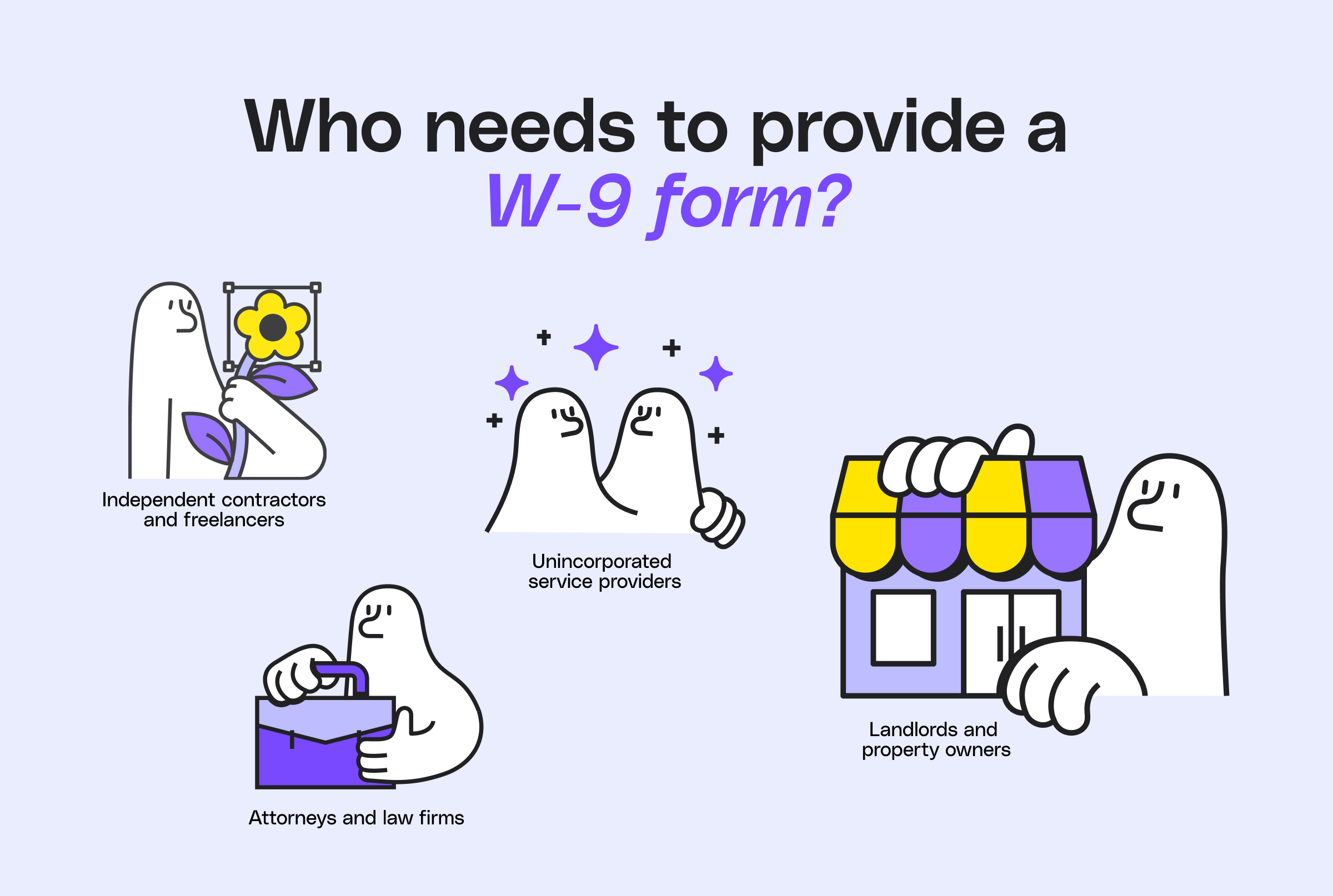
Not every vendor requires one. Understanding which relationships trigger the requirement saves you from unnecessary paperwork requests.
Independent contractors and freelancers
Anyone providing services who isn’t a W-2 employee needs to complete a W-9. Common examples include:
-
A graphic designer who built your website.
-
A marketing consultant you brought in for a project.
-
A photographer who shot your product images.
If they’re billing you for expertise and they’re not on payroll, you need their tax information.
Contractors and freelancers manage their own tax obligations. Your 1099 informs the IRS what you paid them, and the W-9 supplies the identification number that makes that report accurate.
Unincorporated service providers
Sole proprietors, single-member LLCs, and partnerships all fall into W-9 territory when providing services. A single-member LLC might feel like a legitimate company to the person running it. From a tax perspective though, the IRS treats it like a sole proprietorship unless they’ve elected otherwise.
Not sure about a vendor’s structure? Ask for the form anyway. The W-9 includes a section where they indicate their tax classification.
Attorneys and law firms
Legal fees always require 1099 reporting. Always. Even when your attorney works for a professional corporation (a structure that normally exempts businesses from 1099 reporting), you still need their W-9 and still send them a 1099.
Why the exception? Legal settlements and attorney fees get extra IRS scrutiny. Don’t assume your law firm’s corporate status lets you skip this step.
Landlords and property owners
Paying rent to an individual or unincorporated business? That triggers 1099 reporting too. If your office lease payments go to a person rather than a corporation, you need their W-9. The same applies to equipment rentals from individuals or partnerships.
The $600 threshold applies here just like it does for services.
Other reportable payments
W-9 requirements extend beyond just service payments. Royalties, interest, dividends, real estate transaction proceeds, canceled debt, and acquisition of secured property can all trigger reporting obligations. If you’re making these types of payments to individuals or certain business entities, collecting a W-9 keeps you covered.
How to request a W-9 from a vendor
Requesting a W-9 is simple when you build it into how you bring on new vendors. Follow these steps to collect the form without the year-end scramble.
-
Send the vendor a blank W-9 from the IRS website along with your contract.
-
Explain why you need it and how you will store their information.
-
Make a completed W-9 a condition of starting work.
-
Save the finished form in that vendor’s file so it is ready at tax time.
When is a W-9 not required?
Some vendor relationships don’t trigger any W-9 requirement. Knowing when you can skip asking keeps your administrative load manageable.
Payments below IRS thresholds
Reporting threshold: payments of $600 or more triggered a 1099 through 2025. For payments made in 2026 and later, the threshold is $2,000, with inflation adjustments beginning in 2027.
Many businesses still request W-9s from smaller vendors as a precaution. Projects expand. One-time jobs become recurring relationships. Having the form on file means you’re covered if payments unexpectedly cross the line.
Incorporated businesses (C-corps and S-corps)
Payments to corporations generally don’t require 1099 reporting. Corporate vendors typically don’t need to give you their W-9, with attorneys being the exception mentioned earlier.
Uncertain about a vendor’s business structure? The W-9 form includes a tax classification section. If they check the corporate box, you’ll know 1099 reporting isn’t required.
Payments for goods only
W-9 requirements apply to payments for services. Buying office supplies, inventory, or equipment from a vendor? That doesn’t trigger 1099 reporting. The distinction is between paying for what someone does versus what they sell.
A vendor who provides both goods and services complicates things. If most of your payments cover their service work, collecting the W-9 is the safer route.
W-2 employees
Your regular employees don’t need W-9s. Their tax information comes through Form W-4 at hiring, and payroll handles the W-2 reporting. W-9s exist specifically for people who work with your business but aren’t on the payroll.
If you’re uncertain whether someone qualifies as an employee or independent contractor, that’s a separate classification question with its own set of IRS rules.
Foreign vendors and contractors
Here’s one that catches people off guard: W-9 forms are only for U.S. persons. If you’re paying a contractor or vendor who isn’t a U.S. citizen or resident, they don’t complete a W-9. They provide a Form W-8 instead (usually W-8BEN for individuals or W-8BEN-E for entities).
The W-8 series certifies their foreign status for tax purposes. Different rules apply to these payments, including potential withholding requirements. If you’re working with international contractors, the paperwork looks different from day one.
Do you need a W-9 from every vendor?
No, you do not need a W-9 from every vendor. You usually don’t need a W-9 from corporations, tax-exempt organizations, or when payments to a vendor are under $600.
That said, plenty of business owners collect W-9s from new vendors regardless of expected payment amounts. A project that starts at $400 can easily grow. A one-time purchase might turn into a recurring service relationship. Having the W-9 already on file saves you from scrambling later if the numbers shift.
Do nonprofits need to collect W-9 forms?
Yes, nonprofits must collect W-9 Forms from U.S. persons, independent contractors, vendors, and other entities to whom they pay $600 or more annually for services, rent, or other reportable payments, ensuring proper 1099 reporting and compliance with IRS requirements.
This catches some nonprofit administrators off guard. Tax-exempt status means your organization doesn’t pay income tax on its own revenue. It doesn’t mean you can skip the paperwork that reports payments going out to others.
What happens when a vendor doesn’t provide a W-9?
If a vendor won’t provide a W-9, you must start 24% backup withholding on their payments. Skip it and the IRS can penalize you.
This situation comes up more often than you’d think. You send the request, wait a week, send a reminder, wait another week. Still nothing.
First, keep trying. A friendly follow-up often does the trick. Some contractors aren’t ignoring you on purpose. Your email just got buried under everything else. A phone call can move things along when emails aren’t working.
If the vendor keeps ignoring your requests and you still need to pay them, backup withholding kicks in. Because you don’t have a valid taxpayer identification number on file, the IRS requires these steps:
-
Withhold 24% of the payment.
-
Remit the withheld amount to the IRS.
-
Report it on Form 945.
-
Issue a 1099 showing the gross payment and the amount withheld.
That’s extra paperwork for you and less money for the vendor. Nobody wins. The vendor can claim the withheld amount as a credit on their tax return, but they’d rather just have their full payment. This is exactly why collecting W-9s before that first payment makes so much sense. Once money has changed hands, your leverage disappears.
Penalties for missing or incorrect W-9 information
Skipping W-9 collection doesn’t just create inconvenience. It can cost you money.
If you file a 1099 with an incorrect taxpayer identification number, or fail to file one altogether, the IRS can assess penalties. These range from $60 to $340 per form depending on how late you correct the issue, and can reach $680 per form for intentional disregard of the rules.
Mismatched information triggers IRS notices. You’ll spend time researching the discrepancy, contacting vendors for corrected information, and filing amended forms. None of this is how you want to spend your February.
The backup withholding requirement adds another layer. If you should have withheld but didn’t, you could be on the hook for the amount you failed to withhold plus interest and penalties.
Getting W-9s right the first time avoids all of this.
How long should you keep W-9 forms on file?
The IRS can audit your business tax returns going back several years, so your W-9 documentation needs to stick around for a while.
The general rule is to keep completed W-9s for at least four years after you file the tax return that includes the related 1099 information. Paid a contractor in 2025? You’ll file their 1099 in early 2026, then file your business tax return sometime in 2026. Hold onto that W-9 until at least 2030.
A quick example: hiring a freelance designer
Say you bring on a freelance designer for a website refresh project. The quote comes in at $4,500. Here’s how the W-9 process should work:
Before any work starts, you send a W-9 request along with your contract. The designer fills it out, indicating they’re a sole proprietor, and returns it. You save the completed form in their vendor file.
Work happens. Invoices come in. You pay them throughout the project.
Come January, you pull up your records. The designer received $4,500 from you during the calendar year. That’s well above the $600 threshold. You use the W-9 information to prepare their 1099-NEC, file it with the IRS, and send them a copy.
The whole thing takes minutes because you collected the W-9 upfront. No chasing, no delays, no backup withholding complications.
Simplify W-9 collection and 1099 filing with Melio
Melio builds W-9 requests into your payment flow, so forms are collected at onboarding and 1099 data is ready at year-end without manual reconciliation.
Melio weaves W-9 requests into your payment process. Send requests electronically. Track submissions through your dashboard. The integration with Tax1099 means payment data flows directly into 1099 preparation without spreadsheets to reconcile or data entry mistakes to fix.
Managing W-9s and 1099s in the same place where you handle payments keeps contractor relationships organized. Records stay current. Tax deadlines become manageable instead of stressful.
The platform works whether you pay a handful of vendors or manage a large contractor base. The mobile app and desktop version both handle bill payments and tax compliance together, keeping paperwork from eating into time you’d rather spend elsewhere.
W-9 vendor FAQs
Do you need a new W-9 from a vendor every year?
No. A W-9 does not expire, so you only need a new one when a vendor’s name, address, or tax classification changes. Reviewing your vendor list once a year helps you catch those updates.
Can a vendor refuse to provide a W-9?
A vendor can decline, but you still have to protect your business. If they will not provide one, you must withhold 24% of their payments and send that amount to the IRS.
What’s the difference between a W-9 and a 1099?
A W-9 is the form you collect from a vendor to get their tax details. A 1099 is the form you file later to report what you paid them.

Accounting Errors: Common Types and How to Prevent Them
Learn what accounting errors are, the common types, and simple ways to catch and prevent them.

Accounts Payable Automation: How It Works and Why SMBs Need It
Learn how accounts payable automation works and why SMBs use it to save time and control cash flow.

What Is a Fractional CFO? A Guide for Growing Businesses
See what a fractional CFO does, what one costs, and when your growing business should hire one.