What Happens If an ACH Payment Is Returned? ACH Returns Explained
Learn why ACH payments get returned, what it costs your business, and how to prevent it.


Key takeaways
- Recognize the most common ACH return codes, like R01, R02, R08, and R10, so you can fix a returned payment faster.
- Verify account details and confirm authorization before you charge to prevent avoidable returns.
- Keep your Nacha return rates low, with unauthorized returns under 0.5%, administrative returns under 3%, and overall returns under 15%.
- Offer flexible payment options with Melio so customers can pay how they prefer while you still get paid your way.
What is an ACH return?
An ACH return happens when a bank cannot process an ACH payment and sends it back to the sender’s bank with a code that explains why. It works like a bounced check for electronic bank transfers.
A return is different from a reversal and a chargeback. A return comes from the receiving bank when a payment cannot post. A reversal is sent by the party who started the payment to undo one they made in error. A chargeback is a card term, not an ACH one.
Reasons for ACH payment returns
The benefit of these dreaded “your payment was returned by the bank” messages is that they come with ACH return codes that specify the reason. As frustrating as it feels to deal with this, understanding the reason helps you solve the issue faster and minimize the risk. Here are some of the most common reasons your customer’s ACH payment might be returned.
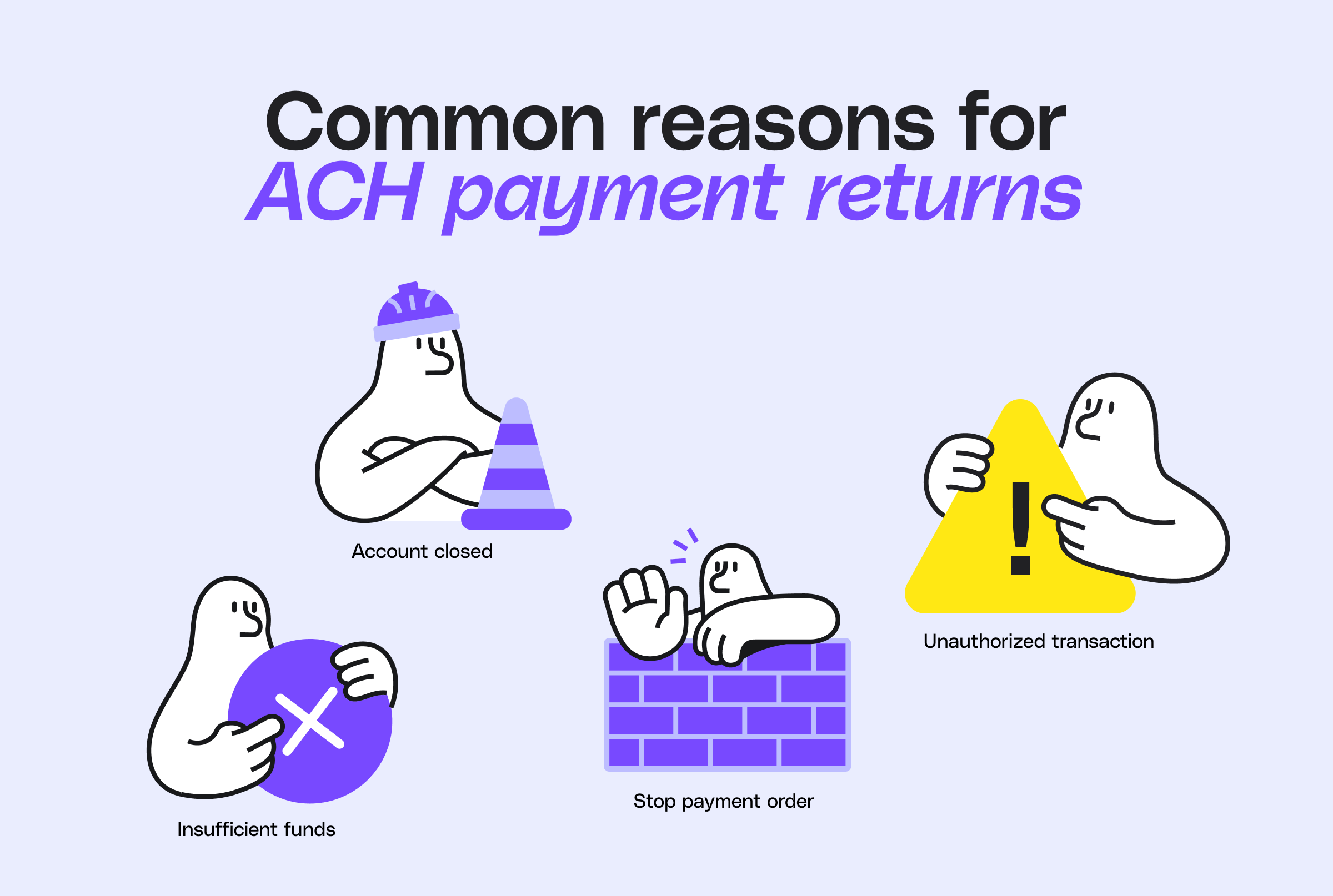
Insufficient funds
- ACH return code: R01.
- Why this happens: Your customer tries to transfer more money than they have in their account.
- What to do about it: Contact your customer. Maybe they made a mistake (say, added an additional digit or didn’t pay attention to their cash flow). Maybe they thought they had the money, but their own customers didn’t pay when planned. They can try the transaction again in two days, or you can work together to find a different payment method.
Account closed
- ACH return code: R02.
- Why this happens: You’re charging an account that no longer exists. This could happen because a customer gave you the wrong account number, or maybe it’s a recurring payment and your customer forgot to inform you that they changed accounts.
- What to do about it: The best advice is almost always communication, so here, too, contact your customer. Ask for updated account information or offer additional ways to pay. If they still want to make an ACH payment, they can try again two days after the attempt that didn’t work.
Stop payment order
- ACH return code: R08.
- Why this happens: Your customer asked to stop all payments to your account. Perhaps they provided long term access to their account through an ACH withdrawal, and are now reviewing their expenses and making some changes. This could happen because of their own financial challenges or because they’ve decided to move on from being your customer.
- What to do about it: Customer turnover is common, but it doesn’t mean you necessarily need to just forget about it and move on, especially if this was a meaningful customer. Try contacting them to find out what happened. Perhaps you can fix the situation, or give them a free gift card for the next time they want to give you a try. If they want to transfer the money again via ACH, they can do it starting two days after they stopped the payment. Even if this doesn’t work, they might be able to give you valuable feedback, which you can use to make your business serve your other customers even better.
Unauthorized transaction
- ACH return code: R10.
- Why this happens: You’re no longer authorized to charge this account. As in the previous code, this could be a mistake or it could be intentional, but in R10, it can also mean a fraudulent transaction.
- What to do about it: If this is a recurring customer, stop recurring or future payments right away. If it’s a customer you know well, consider contacting them, as there might be a mistake. Otherwise, whether there’s a risk that your customer is committing fraud (they’re using someone else’s financial information to buy from you) or accusing you of fraud (for example, if they say they never gave you permission to charge their account), we recommend consulting an attorney.
Other reasons
There are more than 80 reasons that ACH payments get returned. We covered them all in another article, including each reason’s accompanying code, what the reason means, what you can do about it, and what’s your timeframe to take action.
It’s a free, ungated resource to keep handy for when you need to quickly understand the ACH return codes showing up in your system.
How long does an ACH return take?
Most ACH returns come back within two banking days of the settlement date. Returns for unauthorized payments can take longer.
If a customer says a payment was not authorized, their bank can send it back up to 60 calendar days after the payment. Knowing these windows helps you plan your cash flow and follow up on time.
The impact of ACH payment returns
Taking the actions we recommended above is important, because unfortunately, ACH payment returns come with a potentially significant impact.
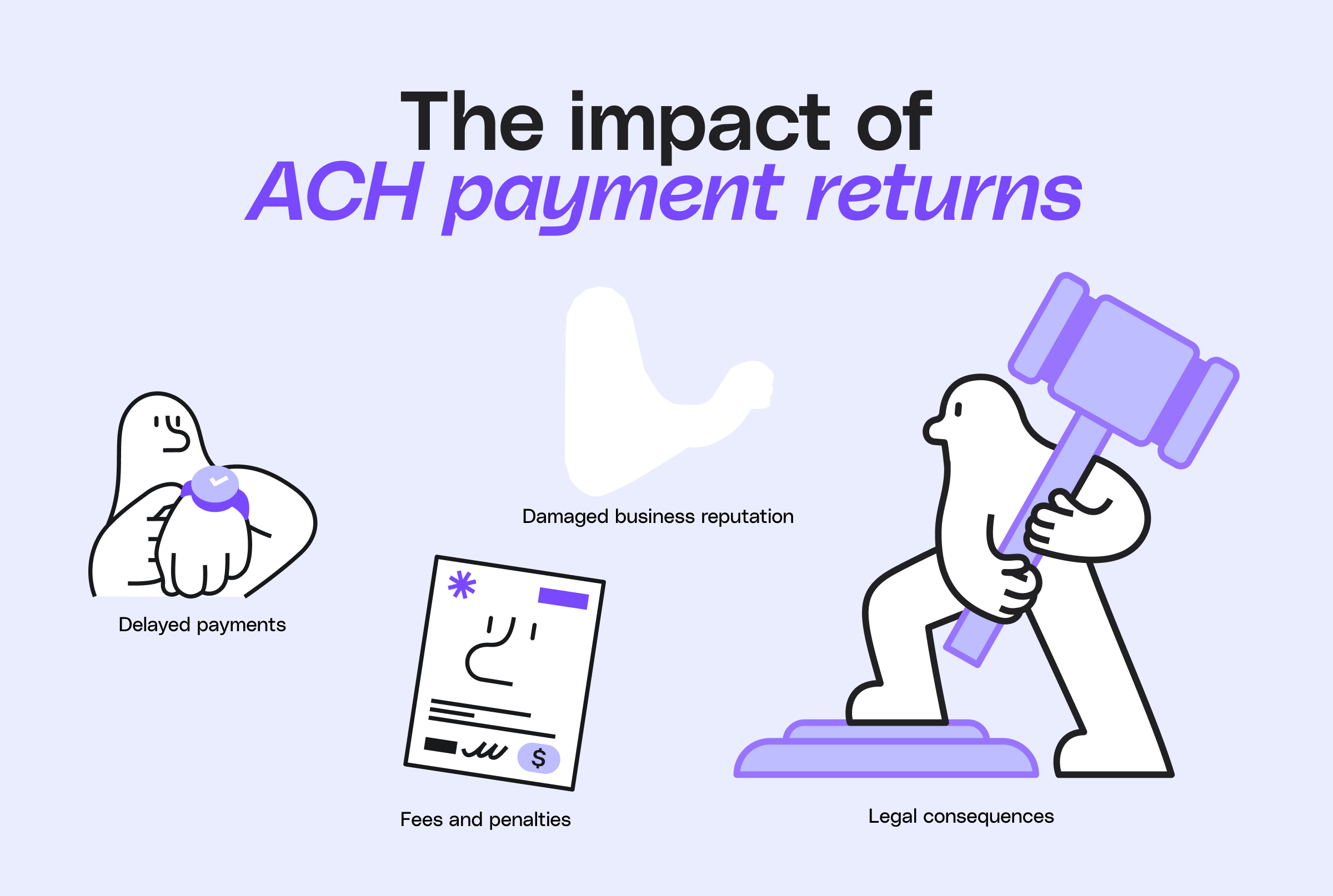
Delayed payments
Needless to say, getting a returned mobile ACH payment notification isn’t pleasant. If your customers’ ACH payments get returned, your own cash flow gets hurt. Your ability to pay your employees and suppliers, pay your bills and taxes, or take home a salary yourself, as the business owner, to support your own family, decreases.
If this keeps happening, the lack of reliable payments and cash flow can also hurt potential investment and expansion opportunities, as the financial ground won’t be solid enough to grow.
Fees and penalties
Returns create more work for your bank, so you might be facing return handling fees. You might be able to hand off these fees to your customer, if she or he caused the return, but this isn’t something to count on.
The fee is $2 to $5 per returned payment, but it can easily accumulate if this keeps happening.
Nacha, the organization that manages ACH payments, also sets return rate thresholds you need to stay under over a rolling 60 days. Keep unauthorized debit returns below 0.5%, administrative returns below 3%, and overall debit returns below 15%. Surpass these rates and Nacha might deny your business the option to keep accepting ACH payments.
Damaged business reputation
If your business gets accused of fraud, or trying to make unauthorized charges, that’s a reputation crisis. Losing the ability to accept ACH payments could also signify to your customers that something problematic is going on.
It could be perceived this way even if you simply came across some really bad coincidences or you realized you hired the wrong person to handle payments, despite your business intention to always serve customers well.
But it can even be simpler than that. If customers trust your ethical intentions, but find it hard to do business with you because they keep needing to spend additional time on payment logistics, they might start looking elsewhere. It’s a lose-lose situation that’s best dealt with as soon as possible.
Legal consequences
Depending on how severe your ACH return rate is, or for what reasons payments get returned, there could be legal and regulatory consequences.
If you see that this might become an issue, we highly recommend consulting with an attorney and getting ahead of it before it escalates.
ACH payment return process
While resolving the issues behind an ACH payment return can sometimes be complex, the actual process of returning the money is pretty simple. Here is how the money flows back.
- The ACH payment processing starts as usual: The customer transfers the money to the ACH network, which transfers the money to your bank.
- The receiving bank (your business’ bank) identifies that there’s a problem with the payment transaction.
- It returns the payment to the originating bank (your customer’s bank—that’s where the payment originated).
- The receiving bank provides an ACH return code to clarify why the payment was returned.
- The account owners and banks now need to work together to solve the issue.
Preventing ACH payment returns
The best way to handle a returned ACH card payment, or a bank transfer one, is to prevent it. Here are a few suggestions to help you.
Verify account information
Always double check account information when it’s your time to insert it or review it before a final charge, and encourage customers to do the same.
Implement risk management strategies
Combine machine and human intelligence to manage the risk that comes with receiving ACH payments (or any payments, really). Use data verification and validation tools for customer and account information accuracy.
Simultaneously, educate your customers on best payment practices, including the fees and penalties that mistakes might lead to. Offer advice carefully, maybe as an added resource, or more directly if you see a customer who’s struggling or repeating the same issue again.
Educate employees
Educate your own employees on best payment practices, too. Teach them how to monitor and analyze return rates, plus how to handle refunds.
When handling refunds, train them how to retain customers in a way that actually makes them want to stay with your business (provide resolution to their issue, accommodate their needs when possible, or offer a free gift card to try your business again when they’re ready). Plus, teach them how to get customer feedback, so you can improve your overall customer relations regardless of whether this specific customer remains.
Then include this information as you teach empathetic and efficient customer service to get more customers to stay with you for the long haul.
Consider alternative payment methods
Thankfully, we live in the age with many business payment options. If ACH payments are giving you or your customers too much trouble, offer additional options to pay for your products and services.
If your customers insist on paying via ACH, but you now prefer—or have—to use a different method, use a third party platform like Melio. With Melio, you no longer need to analyze ACH vs. wire transfer, or any other payment method, to try to figure out what can simultaneously work best for you and your customer. Melio lets your customers pay however they prefer, then converts the payment to your preferred way of receiving money.
Simplify ACH payments and boost financial control
ACH payments have plenty of benefits, including how payment details remain secure and payments transfer quickly.
When you use Melio, your customers can pay in batches, split the bill into different installments, and set up recurring payments. And, as mentioned above, whichever party prefers to pay or gets paid via ACH gets to do so, even if the other prefers a different method.
Either way, payment information remains secure, and you can easily track and analyze payment operations to ensure everything runs smoothly—or to catch a challenge before it escalates. Try it here.
ACH return FAQs
How long does an ACH return take?
Most returns arrive within two banking days of settlement, while unauthorized returns can take up to 60 calendar days.
Who initiates an ACH return?
The receiving bank starts the return, not the sender. It sends the payment back with a code that explains the reason.
How can you avoid ACH return charges?
Verify account details before you charge, confirm authorization, and keep an eye on your return rates. Fewer returns mean fewer fees.
Can you resubmit a returned ACH payment?
Often yes. For an insufficient funds return, you can retry the payment, and for a wrong account number you fix the details and send a new payment.
*This guide is intended for informational purposes only and is not intended as financial advice.
**Melio does not provide legal, tax or accounting advice, and you should consult with a professional advisor before making any financial decisions.

5 tips that could've helped me when I owned a food truck
From the importance of timely payments to why the customer isn’t always right, here’s what Melio employee Rotem Tal learned from running a food business.

How To Turn A Bad Customer Experience Into A Good One
Learn how to turn an unhappy customer into a loyal one and protect your business reputation.

Mastering E-Commerce Payments
As your e-commerce business grows, so do your financial challenges. This guide covers best practices in accounting and payment processing, plus key compliance and data protection tips.