Do W-9 Forms Expire? How Often You Should Update a Vendor’s W-9
Learn when a vendor’s W-9 needs refreshing, what changes trigger a new form, and how to stay ready for 1099 season.


- Key takeaways
- Do W-9 forms expire?
- When do you actually need an updated W-9?
- How do I know if my vendor’s W-9 is still valid?
- What happens if you don’t update a W-9?
- Best practices for keeping W-9s current
- How to request an updated W-9 from vendors
- What to do when a vendor stops responding?
- Does a W-9 need to be updated every year?
- What if a vendor ignores my request for an updated W-9?
- How Melio makes W-9 collection easier
- Keeping W-9s current
- W-9 update FAQs
Key takeaways
- Recognize that a W-9 does not expire, so you only need a new one when a vendor’s name, TIN, or business structure changes.
- Request an updated W-9 right away when a vendor loses an exempt status or the IRS tells you to start 24% backup withholding.
- Collect W-9s before the first payment and review your vendor files each year to avoid a scramble at 1099 season.
- Avoid IRS penalties of up to $340 per form by keeping vendor tax details accurate and on file.
Do W-9 forms expire?
W-9 forms do not officially expire, as long as the vendor details are still the same. Many businesses choose to request updated W-9 forms every few years to keep their records accurate, even though the IRS does not require it. That form you collected five years ago from a vendor whose name, address, tax ID, and business structure haven’t budged? Still perfectly usable.
Still, many businesses assume that W-9s require annual renewal and add this step to their processes. That’s not necessarily wrong, but it is redundant if the vendor name and tax details stayed the same. The IRS doesn’t require checking on vendors, but you can still do so to maintain file accuracy.
Think of it this way: Validity hinges on accuracy, not age. A W-9 doesn’t become invalid because of old age. What can grow stale is the information printed on it.
When do you actually need an updated W-9?
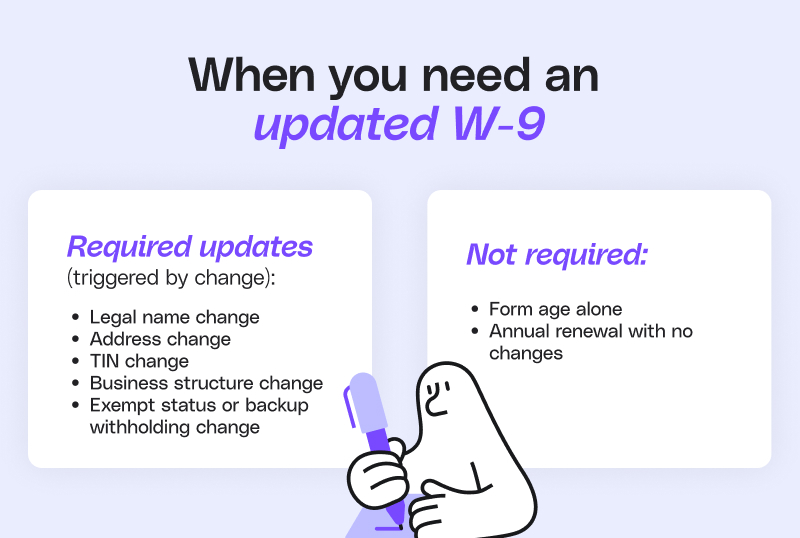
You need a new W-9 when a vendor’s legal name, TIN, business structure, exempt status, or backup withholding status changes. An address change alone does not require a new W-9.
- Legal name — Name mismatches cause IRS errors during TIN matching.
- TIN — A new tax ID makes the old form invalid.
- Business structure — Structural changes affect tax treatment.
- Exempt status or backup withholding — A change here means your records must match right away.
You can also request a new W-9 anytime for record accuracy.
Legal name changes
Legal name changes happen more than you’d think. Marriages, divorces, business rebrands, mergers. The name on your W-9 must match IRS records for TIN matching. A mismatch between your 1099 and IRS files creates exactly the kind of headache you’re trying to avoid.
Address updates
Address updates matter because 1099 forms get mailed. Outdated addresses mean returned envelopes, delayed forms, and compliance annoyances. Vendors rarely mention they’ve moved, which unfortunately means that the asking is on you.
TIN changes
TIN changes make old W-9s invalid. When a sole proprietor incorporates and gets assigned a new EIN, or someone obtains an ITIN, the previous form becomes outdated. New number means new paperwork.
Business structure shifts
When business structure shifts, old W-9s become obsolete. Line 3 of the W-9 captures tax classification: sole proprietor, LLC, S-corp, C-corp, partnership. Those changes require updated documentation. So, for example, a freelancer who formed an LLC last spring or an LLC that elected S-corp status would require different tax treatment.
Changes to the exempt status or backup withholding requirements
You must get a new W-9 immediately if a vendor’s exempt status changes or the IRS tells you to begin backup withholding. This is not optional documentation once withholding applies. When a vendor loses an exemption or becomes subject to backup withholding, your records have to match their new status right away.
And one more thing. You can request an updated W-9 whenever you want. Vendors should comply. It’s a normal part of doing business, and it’s reasonable to ask for fresh information if you’re unsure whether a W-9 is still accurate.
How do I know if my vendor’s W-9 is still valid?
A vendor’s W-9 is still valid if their legal name, TIN, business structure, and address have not changed. Confirm the details match IRS records, especially for TIN matching. The W-9 requires an update if there’s been a name change, move, new EIN, or tax classification shift.
The key thing to consider here is how you know if any changes have been made? Vendors aren’t required to notify you of updates unless you’ve specifically asked them to.
Watch for signals like:
- Invoices arriving with a different business name than what’s on file
- A casual mention during a call that they incorporated
- An address that bounced mail last quarter
Any of these warrants requires a fresh request.
Some businesses verify vendor info in October before year-end deadlines or run IRS TIN matching pre-1099 filing to grab updated W-9s from mismatches. Neither counts as mandatory. Both prevent filing surprises.
What happens if you don’t update a W-9?
If you fail to update a W-9, you face real consequences like backup withholding, IRS penalties, and damaged vendor relationships. A name or TIN mismatch results in a B notice and 24% withholding.
Incorrect 1099s lead to per-form fines. Your business may owe tax plus interest to the IRS if withholding is skipped. These aren’t abstract compliance concerns. They show up in specific, tangible ways.
Backup withholding kicks in
Backup withholding begins when the IRS identifies a name or TIN mismatch and issues a B notice. You must withhold 24% of all future payments and remit them to the IRS if the vendor doesn’t respond. This amount is federal tax withholding, not a penalty.
The vendor can recover the funds on their tax return, but payments remain reduced by 24% until correct information is provided, often damaging vendor relationships.
IRS penalties stack up
IRS penalties stack up when filing 1099s with incorrect names or TIN combinations. Current rates start at $60 per form if you correct within 30 days, $130 per form if you correct between 31 days and August 1, or $340 per form if you miss the August 1 deadline entirely. Multiply that by the number of all 1099s, and the math gets painful quickly. Intentional disregard carries even steeper consequences: $680 per form minimum with no cap.
You might owe taxes you never collected
The business that failed to withhold may end up owing the 24% plus interest to the IRS if the backup withholding should have happened, but didn’t. The IRS collects the tax from you, not the vendor, if withholding was required and not taken. Recovering those funds from a vendor after payment, especially a former vendor, is difficult and often unsuccessful.
The practical fallout is messy
The practical fallout creates operational disruption. Payments are delayed while paperwork is corrected. Amended 1099s require resubmission. IRS notices trigger additional follow-up. Vendor relationships deteriorate when 1099s arrive late or contain errors.
Best practices for keeping W-9s current
The five best practices for keeping W-9s current are:
- Collecting W-9s before the first payment: Not after. Not eventually. Before. Adding two minutes to vendor onboarding prevents chasing them after finishing their project, getting paid, and having zero incentive to respond to your emails anymore.
- Reviewing your records in October: You’ll have buffer time before deadlines, 1099 contractors are still engaged with current work, and reaching out feels natural. Send targeted requests to vendors you haven’t heard from in a while.
- Running a periodic refresh every few years: Re-collect W-9s from all active vendors every three or four years. Conservative? Sure. It catches updates vendors forgot to mention, though.
- Grabbing the current IRS form version: Download directly from IRS.gov each time. That 2018 template sitting in your shared drive? Replace it. The IRS released an updated W-9 in March 2024.
- Retaining completed W-9s for four years after the last related 1099: Secure digital storage with backups and access limits works best.
How to request an updated W-9 from vendors
Requesting an updated W-9 collects current tax information so your 1099 reporting stays accurate and compliant. Most vendors respond to the first request, though some might need reminders. To collect a current W-9, follow these steps:
- Attach the current IRS Form W-9 to a formal email or letter.
- Explain that updated forms are required for accurate 1099 reporting and federal compliance.
- Set a clear deadline for the vendor to return the form.
- Follow up with a reminder if the vendor does not respond.
What to do when a vendor stops responding?
When a vendor stops responding, you’re deciding whether the relationship is worth the compliance hassle. For a contractor you work with regularly and pay well, whether they are a marketing consultant, or a builder who helps with office maintenance, persistent follow-up makes sense. For someone you paid once three years ago? The calculation shifts.
Platforms like Melio build W-9 collection directly into your payment workflow. Adding a new vendor prompts a W-9 request before processing the first payment. One click sends an email with a secure link. The vendor fills out the form online, and their information is stored automatically.
For existing vendors missing current W-9s, you can send bulk requests and track responses through a dashboard showing who’s current, pending, or overdue. Reminders go out on the schedule you set. Everything connects to 1099 preparation.
Does a W-9 need to be updated every year?
A W-9 does not need to be updated every year unless the information changes. The IRS only requires a new W-9 if the vendor’s name, tax identification number (TIN), or business structure changes.
Still, some businesses ask for fresh W-9s every year anyway, to maintain records or in cases of high contractor turnover with risk of outdated records or industries where business structures change often (consulting, technology, or creative). These vendors often incorporate or switch tax classification, resulting in frequent W-9s refreshment.
Requesting annual updates is also a form of insurance. You catch changes before they become problems during the 1099 season instead of scrambling to fix mismatched names and TINs when January rolls around.
What if a vendor ignores my request for an updated W-9?
Follow up with one or two friendly reminders explaining 1099 needs if a vendor ignores your initial W-9 request. A one-week follow-up, then two weeks. Some vendors genuinely don’t understand why you need this.
After three attempts with no response you can:
- Pause payments until documentation arrives
- Continue making payments and accept the compliance risks
None of those choices feels great, which is why upfront collection is always recommended, as it prevents this hassle. Collecting W-9s before the first payments motivates cooperation every time. When vendors have a clear incentive to cooperate, they usually do.
How Melio makes W-9 collection easier
Melio makes W-9 collection easier, especially if chasing W-9s sounds like exactly the kind of task you’d rather not think about.
When you add a new vendor in Melio, the platform prompts you to request their W-9 before that first payment goes through. One click sends a professional email with a secure link. The vendor fills out the form online from their phone or computer, and their information is stored automatically. No printing, no scanning, no email attachments floating around with sensitive tax IDs exposed.
For vendors already in your system who are missing current W-9s, you can send bulk requests and track responses through a dashboard that shows exactly who’s current, pending, or overdue. Reminders go out on the schedule you set, so you’re not manually following up with everyone who forgot to respond.
Everything connects directly to 1099 preparation, too. The taxpayer identification numbers flow from W-9s to 1099s without anyone retyping anything, which means fewer errors and fewer IRS notices about mismatched information.
The system works whether you have five vendors or five hundred. W-9 management that slips through cracks until January panic sets in becomes a non-issue when built into regular payment workflows.
Keeping W-9s current
To keep W-9s current, you should know that W-9 forms don’t expire. The information on them can expire, though. Annual updates aren’t mandatory. Periodic check-ins make sense. Any change to name, TIN, address, or business structure means fresh documentation. And the consequences of working with stale information, including 24% backup withholding and per-form penalties of up to $340 or more, make getting this right worth the effort.
For businesses with a few vendors, manual tracking in a spreadsheet works fine. For larger vendor counts, Melio handles W-9 collection as part of regular payment processing.
Ready to stop chasing paperwork? Sign up for Melio and collect W-9s as part of your regular payment workflow.
W-9 update FAQs
How long is a W-9 form valid?
A W-9 stays valid for as long as the details on it are correct. There is no set expiration date. You only need a new one when the vendor’s name, TIN, or business structure changes.
Do I need a new W-9 every year?
No. You do not need a new W-9 each year unless something on it changes. Many businesses still review their files once a year to catch updates early.
How do I check if a vendor’s W-9 is still valid?
Compare the name, TIN, business structure, and address on file with what the vendor uses today. If anything has changed, request a fresh form before your next payment.
Is there an updated W-9 form for 2026?
The most recent version of Form W-9 is the March 2024 revision. Download the current form from the IRS each time you request one so vendors complete the latest version.

What Is a SWIFT Code? Format, Examples, and How to Find It
Learn what a SWIFT code is and how to use one to pay your international vendors with confidence.

How Expense Reimbursements Work for Small Businesses
Understand how expense reimbursements work for small businesses, from what qualifies to staying IRS compliant.

Small Business Financial Metrics to Track for Your Business Health
See the few financial metrics that show whether your small business is truly healthy.