Early Payment Discounts Explained: How They Work And When To Use Them
Discover how early payment discounts can lower your costs and boost cash flow when you pay invoices ahead of time.


- Key takeaways
- What are early payment discounts?
- How early payment discounts work (with examples)
- How to calculate an early payment discount
- Types of early payment discounts
- What are the benefits of offering an early payment discount?
- A win-win for small businesses and their suppliers
- When to take advantage of early payment discounts
- How to take advantage of early payment discounts as a customer
- So, what’s the problem?
- Early payment for the win
- Early payment discount FAQs
Key takeaways
- Compare each discount’s annualized return to your cost of capital before you decide to pay early.
- Prioritize invoices with the highest discounts when cash is limited to maximize your savings.
- Schedule payments with an accounts payable tool so you never miss the early payment window.
- Ask suppliers for terms like 2/10 net 30 when a discount is not offered upfront.
What are early payment discounts?
Early payment discounts are incentives that sellers offer buyers to encourage them to pay their invoices sooner. Typically, this means that a seller or vendor will provide a discount on the amount due in exchange for the customer paying the invoice early.
For example, imagine you buy something from a store, and they give you a special offer: “You have 30 days to pay for this, but if you pay within 10 days, we’ll give you a 3% discount.” That’s basically what “3/10 net 30” means. If the payment is not made within 10 days, the discount is no longer applicable and you need to pay the full amount.
Early payment discounts are beneficial to both buyers and sellers. Buyers can save significant money by paying early and receiving discounts, while sellers receive money sooner, which means preventing late payments, reducing financial risk, and boosting cash flow.
How early payment discounts work (with examples)
In essence, an early payment discount is offered by suppliers to motivate their customers to pay sooner, in exchange for reduced payment.
Let’s take a closer look at an example of a discount for early payment.
A supplier of packaging goods offers an early payment discount to one of their regular clients, a chain of gift stores. The supplier extends a term of 2/10 net 30 to incentivize the customer to pay early. The chain owner typically spends thousands of dollars each month on packaging goods, so a 2% discount for payment within 10 days, rather than 30, is a favorable arrangement that brings significant cost savings over the course of a year.
Early payment discounts come in various formulations. A prompt payment discount example could include terms such as:
- 2/10 net 30: A 2% discount if paid within 10 days. Otherwise, the full amount is due in 30 days.
- 1/15 net 45: A 1% discount if paid within 15 days. Otherwise, the full amount is due in 45 days.
- 3/5 net 20: A 3% discount if paid within five days. Otherwise, the full amount is due in 20 days.
For customers who have adequate cash available, or those paying their bills with a credit card, the discount that comes with early payment can be a powerful incentive.
Let’s take a look at another example of an early payment discount offered to customers by the seller. This time, the customer who is paying early, Michael, is a Melio user.
Michael owns a retail store specializing in unique hardware for residential doors. With Melio, he was able to schedule a payment in time to take advantage of the early payment discount offered by a vendor. The invoice due was $5,000 with 2/10 net 30.
Michael paid $4,900 within 10 days, saving $100 on the $5,000 invoice. That 2% saving over 20 days works out to an annualized return of about 36%. Even a smaller discount, like 1/10 net 30, can be a great deal.
How to calculate an early payment discount
To decide if an early payment discount is worth it, work out the annualized return and compare it to your cost of capital. The higher the return, the more it makes sense to pay early.
Divide the discount rate by the amount you still owe, then multiply by how many times the payment window fits into a year.
For 2/10 net 30, you save 2% for paying 20 days early. That is an annualized return of roughly 37%, far more than most businesses earn by holding that cash.
When the annualized return beats what you would earn by keeping the money, paying early is usually the smart choice.
Types of early payment discounts
There are three main types of early payment discounts:
- Static discounts: A flat rate for paying early, such as 5% off if you pay within 10 days of receiving the invoice.
- Sliding scale discounts: The discount shrinks over time, such as a 5% maximum that drops 0.5% every five days.
- Dynamic discounts: Negotiated per vendor and per invoice, usually following a static or sliding-scale pattern.
What are the benefits of offering an early payment discount?
A discount on an invoice is a pretty strong incentive for a customer. The reduced payment, as well as the annualized return, add up to some nice cost savings. It is easy to see why early payment might be attractive to the buyer.
But what about the seller? Why would a vendor offer a cash discount to a customer? Apart from the obvious advantage of money in the bank sooner, what are some more benefits to businesses of offering early payment discounts?
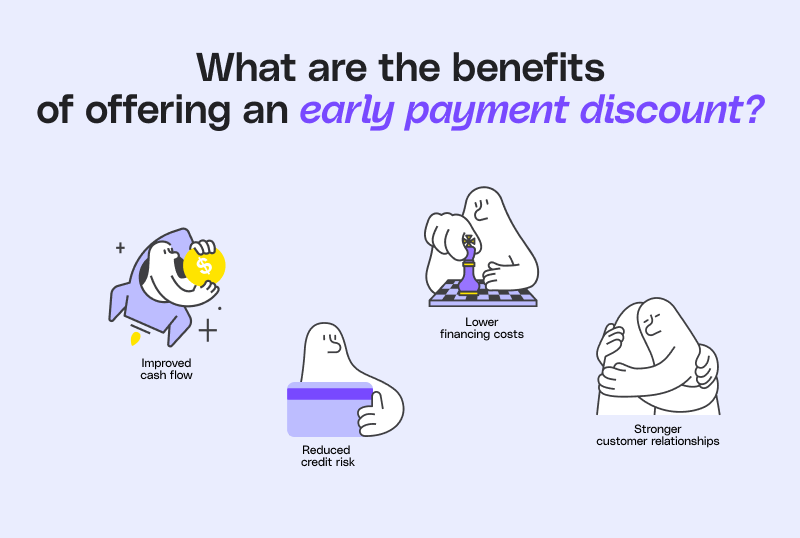
- Improved cash flow: This is perhaps the key benefit of early payment discounts. Although the money received is less than the initial invoice amount, it is deposited sooner, which increases cash flow in the short term. The increase in incoming cash gives businesses the opportunity to use the cash smartly, such as reinvesting in operations, scaling operations, paying off debts, or simply managing expenses more effectively.
- Reduced credit risk: By encouraging early payments, businesses lower the risk of late or defaulted payments, which helps improve their overall financial stability.
- Lower financing costs: With faster cash inflow, businesses may need to rely less on external financing, such as lines of credit or loans. This leads to reduced borrowings and debt, and lower interest payments.
- Stronger customer relationships: Every customer loves a discount. Offering discounts in return for earlier payment provides a cost-saving incentive that many customers appreciate. Also, early payment discounts differentiate the business, giving it a competitive edge in the market. All of this leads to increased goodwill, stronger customer relationships, and repeat business.
A win-win for small businesses and their suppliers
It’s not just the big market players or the bulk buyers who benefit from early payment discounts. Early payment incentives can play a key role in optimizing B2B payments, helping both parties achieve better financial stability and trust—making them a win-win for small businesses and their suppliers.
For suppliers, it’s a win because cash flow will increase when they’re paid faster. For the small business, the costs of goods are reduced, which can increase the margin of products or services. These savings, however small per invoice, can add up and contribute to a modest yet impactful increase in the small business’s cash flow.
In addition to cost savings and increased cash flow, early payment discounts help build strong relationships between businesses and their suppliers, which is a key factor in the success of small businesses. When small businesses have good relationships with suppliers, they are likely to receive better service levels, flexible delivery times, or assistance during exigent circumstances.
When to take advantage of early payment discounts
While discounts are always welcome, early payment discounts may not always be the right choice or best option for your business. The ability to pay early depends on several factors, such as cash flow, the length of the invoicing cycle, and other due payments and debts.
Early payment discounts make the most sense when:
- You have enough cash to pay early without straining your other commitments.
- The annualized return beats what the same cash would earn elsewhere.
- Your invoice approval process is fast enough to meet the discount deadline.
- You can prioritize the invoices with the biggest savings.
How to take advantage of early payment discounts as a customer
Early payment discounts are easy to manage. With a little planning and support from smart accounts payable tools like Melio, you can capture them. Here are the steps to follow if you want to take advantage of early payment discounts as a customer:
- Review early payment terms: Identify invoices offering discounts for early payment. These are typically expressed as “2/10 net 30” or “1/10 net 30”, for example. If the supplier has not specified early payment discount terms, you can contact them to request and negotiate favorable terms.
- Check cash availability: The next step is to verify that you have the available cash flow to pay the invoice early without affecting other financial commitments. If you’re debating whether or not you should pay bills with a credit card and don’t have sufficient cash this month, using a credit card can be a smart way to avoid missing out on the early payment savings.
- Prioritize payments according to discounts: Pay the invoices with the highest discounts first to maximize your potential savings. If you can’t pay all the early invoices in a given month, then it is best to pay the ones with the best returns.
- Schedule payments: Use Melio to set up automated payments or reminders to ensure you pay on time and don’t miss out on the discounts.
- Monitor cash flow: Keep a close eye on your cash flow to make sure you can continue to take advantage of early payment discounts without adding too much stress to your accounts payable operations.
So, what’s the problem?
There may be certain obstacles for small businesses that want to take advantage of early payment discounts, but there is usually an available workaround—and Melio is here to help.
When the business has limited cash flow:
For small businesses with negative cash flow, paying an invoice early may not make sense. However, they can still benefit from early payment discounts by paying the vendor by credit card and deferring the bank account withdrawal till later. With Melio, businesses can pay with a credit card, even when the supplier only accepts checks, so that never has to be the reason to forgo an early payment discount.
Another workaround is using a single use virtual card (SUVC), which offers added payment security and can be used to unlock flexible payment options while staying eligible for discounts.
Always be sure to check whether your supplier charges B2B credit card processing fees, as these could reduce or negate the value of any discounts you’re receiving.
When the invoice approval process is too long and misses the early payment timeframe:
The average invoice processing cycle is about 14.6 days from invoice receipt until payment is disbursed, which misses the allotted time frame for early payment discounts. However, small businesses that have a simple and fast invoice approval process can take advantage of these discounts and even use Melio to schedule a payment, so they are sure not to miss the deadline.
When the supplier does not offer early payment discounts:
While early payment discounts have many advantages for suppliers, they may not be set up to administer or manage them. If the supplier does not offer an early payment discount, and you would like to get a discount in return for paying early, you can request it. We recommend asking your supplier for 2/10 net 30 if an early payment discount is not offered upfront in the payment terms.
Early payment for the win
Allowing cash to sit in your account isn’t getting you the best return from your assets. Early payment discounts are valuable tools that small businesses can use to generate a higher overall rate of return.
There are some challenges to meeting early payment deadlines, such as cash flow requirements, and accurately scheduling payments to arrive on time. However, if you can overcome these obstacles, early payment discounts deliver an impressive annualized return. At the same time, they boost your relationship with vendors, positively impacting your business in the long run.
When negotiating early payment discounts with your suppliers, be sure to request mutually beneficial payment terms that will have a net positive effect for both parties.
With Melio as your accounts payable partner, you can schedule early payments, pay suppliers with a credit card, or enjoy fast delivery options. This way, you can leverage early payment discounts to your advantage, and get the maximum returns for your business.
For more business credit card tips, look into combining early payment strategies with smart card usage to stretch your cash flow even further.
Early payment discount FAQs
Are early payment discounts worth it?
They are usually worth it when the annualized return beats your cost of capital and you have enough cash to cover your other bills. If paying early would strain your cash flow, it may not be the right move that month.
What is the difference between an early payment discount and a trade discount?
An early payment discount rewards you for paying an invoice before the due date. A trade discount is a reduction off the list price at the point of sale, often based on volume or customer type.
Can you ask a supplier for an early payment discount?
Yes. If a supplier does not offer one, you can request it. A common starting point is to ask for 2/10 net 30 and negotiate terms that work for both sides.
How are early payment discounts recorded in accounting?
Buyers usually record the discount as a reduction in the cost of the purchase or as other income. Sellers record it as a reduction in revenue. Check with your accountant to match your bookkeeping method.
*This blog post is intended for informational purposes only and is not intended as financial advice.
**Melio does not provide legal, tax or accounting advice, and you should consult with a professional advisor before making any financial decisions.

How To Create An Effective Content Marketing Strategy
Build a content marketing strategy that fits your small business, saves time, and keeps customers coming back.
The story behind Melio’s Small Business Season
Get a behind the scenes look at why Melio’s Small Business Season campaign was created and the steps that guided more businesses to success.

Prorated meaning: What it is and when it applies to your business
Learn how prorated charges keep costs fair, smooth cash flow, and simplify billing for your team.