How To Avoid B2B Credit Card Processing Fees
Learn how to accept credit cards for B2B payments and keep processing fees off your bottom line.


- Key takeaways
- What’s stopping B2B credit card payments?
- How businesses pay businesses, and why they’re doing it wrong
- Different components of processing fees
- How much does it cost to accept credit cards?
- How to prepare for processing fees in B2B transactions
- Why B2B businesses need to accept credit card payments
- Can I get that for free instead?
- More choice for your customers, zero cost to you
- B2B credit card processing fees FAQs
Key takeaways
- Compare the true cost of each payment method, since checks, wires, and standard ACH all carry time or fees that eat into B2B margins.
- Break processing fees into interchange, network, and processor charges so you know exactly what you pay and where.
- Lower your costs by surcharging compliantly, negotiating your processor rate, or steering customers toward lower-cost methods like ACH.
- Accept cards at little to no cost by using Melio to pass the fee to customers or absorb it while getting paid in full.
What’s stopping B2B credit card payments?
The average US consumer has about 3.7 active credit cards. In the B2C industry, businesses have little choice but to accept credit cards or lose customers.
For B2B companies, payment methods such as direct deposits, wire transfers, and checks are still the most common and popular. Business owners may be less inclined to change their ways and make the move to accept credit cards.
They may be even more reluctant about the cost of credit card processing fees and how it could affect their business’s bottom line.
On the upside, credit card transactions are processed on the spot, so businesses can get payment confirmation instantly. This eliminates the time spent waiting for checks in the mail and depositing them in the bank. Checks can also get lost or stolen, or simply bounce, further distancing you from the money at the end of the tunnel.
Avoiding card fees can feel like a short-term win. Over time, though, B2B customers who prefer cards may take their business elsewhere to find the flexibility they want. By not accepting cards, you could be leaving customers and revenue on the table.
How businesses pay businesses, and why they’re doing it wrong
B2C businesses are typically flexible with their payment methods. Even if they choose to avoid the high fees of traditional credit card processors, B2C companies have more payment alternatives to offer customers, such as mobile payment apps.
Business transactions, on the other hand, can be complex and rigid, leaving just a few payment options, including cash, wire or bank transfers, and paper checks.
Here’s why these are not always ideal for business payments:
- Cash: Many B2B businesses work with high volume payments. They may be selling inventory in bulk, or dealing with expensive bills for equipment and services. Paying in cash is not a safe or realistic option. In many countries, caps have been placed on cash payments limiting the amount that can be paid in cash, making large cash payments impossible.
- Checks: This classic payment method is highly subject to fraud and theft. It’s also cumbersome, prone to error, and surprisingly expensive once you factor in labor, materials, postage, and reconciliation.
Bank transfers: ACH bank transfers are a convenient, inexpensive way to pay business bills. However, standard transfers typically take one to two business days to settle. This makes them less appealing when a bill is due or there’s an early bird discount to collect. Wire transfers are faster, arriving within 24 hours, but they’re expensive, usually costing around $25 to $30 per transaction.
Different components of processing fees
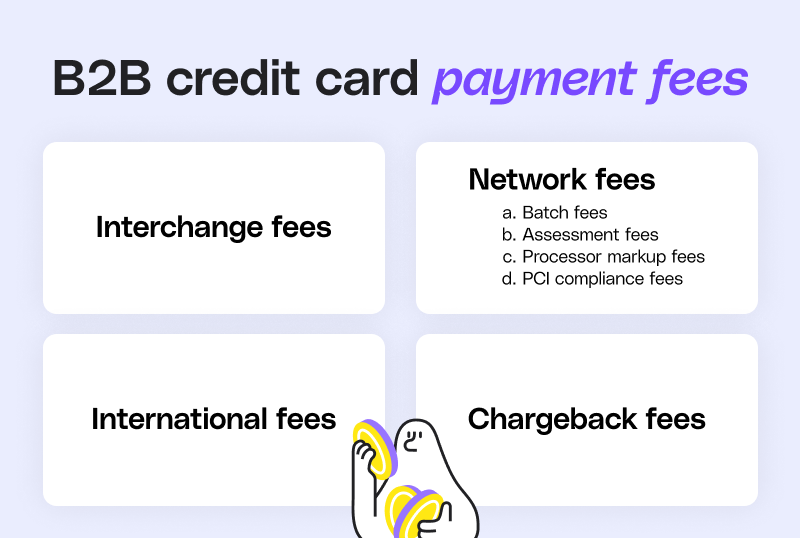
There is no such thing as a free lunch, and there is no such thing as a free credit card payment either.
There are many parts to the credit card transaction, with several fees along the way (many of which are hidden). Let’s take a look at the different types of processing fees that make up the overall cost of B2B credit card payments:
- Interchange fees: These are the fees paid by the merchant’s bank (acquiring bank) to the cardholder’s bank (issuing bank) whenever a credit card transaction is processed. It covers the risk involved for the issuing bank in approving and handling the payment.
For example, Business A pays a bill for $10,000 worth of office supplies from Business B, using a Visa credit card. Let’s say that the interchange fee is 2.25% + $0.10.
Visa forwards $9,774.90 to Business B’s bank account ($10,000 minus the interchange fee of $225.10). The $225.10 interchange fee is kept by the issuing bank as compensation for handling the transaction.
- Network fees: There is a complex network behind the scenes that facilitates credit card transactions. The network is made up of credit card companies, payment processors, banks, and financial institutions. Various activities in the network incur fees, including:
- Batch fees go towards closing out and settling the batch of daily transactions.
- Assessment fees are charged by the credit card networks (ie, Visa, American Express, etc) to the acquiring bank for each transaction.
- Processor markup fees are additional fees that may be charged by the payment processor for handling the transaction.
- PCI compliance fees ensure that a merchant complies with the Payment Card Industry Data Security Standard (PCI DSS), required for handling credit card data.
- And more.
- International fees: Transactions involving international cards or currencies incur additional processing fees and currency exchange fees. This is a percentage of the transaction amount, typically higher than domestic charges.
- Chargeback fees: When a customer disputes a credit card transaction and the issuing bank reverses the charge, the business pays a chargeback fee. Different card processors charge different amounts for chargeback fees. Maintaining comprehensive payment records is essential to avoid payment disputes and chargeback fees.
How much does it cost to accept credit cards?
Accepting credit cards usually costs between 1.5% and 3.5% of each transaction. The exact rate depends on the card type, your payment processor, and your transaction volume, and online payments tend to sit at the higher end.
Across Visa and Mastercard, the average effective swipe fee was about 2.36% in 2025. Fees like these add up and can dent net profit margins, especially on larger B2B payments.
How to prepare for processing fees in B2B transactions
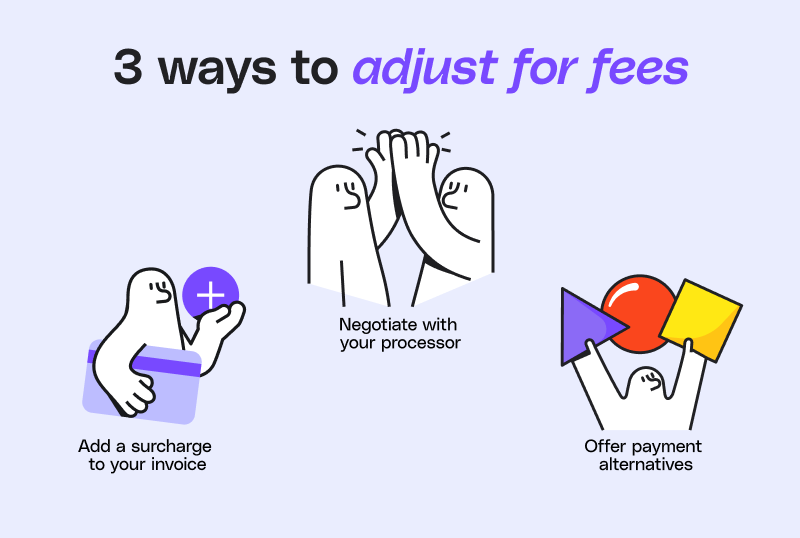
B2B credit card processing fees are simply a part of life for bookkeepers and business owners. Even so, there are ways to optimize interchange fees, reduce processing costs, and get the maximum return on your B2B transactions. Here are some ideas to try:
Add a surcharge to your customer invoice
Some businesses reduce processing fees by passing the credit card fee onto the customer. This is called “surcharging”. For example, the owner of a fitness studio has a $100 bill to pay to a marketing consultant, and they decide to do so with a B2B charge on credit card. The consultant adds a $3 surcharge to cover the 3% credit card fee. Therefore, the total amount that the studio owner must pay is $103.
Businesses don’t have to pass on the entire credit card processing fee to the customer. You can choose to share the cost with the customer, adding a smaller surcharge to offset part of the processing fee. This is good for building business relationships, as it makes the customer feel that they are being dealt with fairly.
According to the law, businesses must clearly disclose the surcharge to customers before completing the transaction. This gives the customer the option to choose a different payment method if they don’t want to pay the processing fee. Also, businesses are not allowed to profit from a surcharge. The maximum amount must not be higher than the actual cost of the processing fee.
Negotiate with your processor
Processing fees are not necessarily set in stone, and there is always room to negotiate with payment processors for better terms. To start, analyze your financial data so you get an understanding of your transaction volume and payment frequency. Then, contact different payment processors to see what they can offer. You can ask for reduced rates, request that certain fees be waived, or even discuss custom pricing. If you have a high volume of transactions, use that leverage to get the best possible deal.
Offer payment alternatives
While credit cards are extremely convenient, they usually come with higher processing fees. Business owners can encourage customers to pay via lower-cost methods, such as ACH transfers, and reduce their overall processing fees. In fact, Melio’s free plan includes free ACH bank transfers up to a monthly limit, with paid plans for higher volumes, making it a cost-effective alternative for B2B payments.
Another no-fee payment alternative is cash, of course. However, for most businesses, accepting cash payments on a regular basis is just not feasible. Choosing a credit card payment processor with competitive rates is a better way to expand your payment options and minimize fees.
Why B2B businesses need to accept credit card payments
Better cash flow, card rewards, convenience, and habit are just a few of the reasons why your business customers may want to pay you with a card.
Why should you accept? Mainly, because you just don’t want to leave money on the table and lose business. Flexibility can be a serious business advantage, attracting new customers and preserving your existing clientele. Better payment choices also mean better relationships with your customers, translating into more sales and referrals.
And, as already mentioned, credit card payments are fast, giving your cash flow a boost when you may need it.
Can I get that for free instead?
With Melio’s digital payment platform, absolutely!
Just use Melio to process incoming B2B payments and give your customers the choice to pay with a credit card. You’ll get the money directly to your bank account within a day. When setting up your account, you can choose whether you want to cover the credit card fee or pass it on to your customer as a full or partial surcharge.
In other words, your business customers can choose to pay you with a credit card and it doesn’t have to cost you extra. They enjoy the added convenience and improved cash flow, while you get the full amount directly to your bank account.
More choice for your customers, zero cost to you
Give your customers all the options without affecting your workflow or costing you a penny. Sign up for Melio today to start accepting credit card payments from your B2B customers for free.
B2B credit card processing fees FAQs
Is it illegal to charge a 3% credit card fee?
No. Surcharging is legal in most states, though a few states still restrict it and card networks cap the amount you can add. You must disclose the surcharge before the sale and never charge more than your actual processing cost.
What is a B2B charge on a credit card?
It is a card payment one business makes to another, often for invoices, supplies, or services. These charges carry the same processing fees as any other card payment.
Is a 3% transaction fee high?
A 3% fee sits at the higher end of typical processing costs, which usually run between 1.5% and 3.5%. Whether it is worth it depends on the sale size and how much your customers value paying by card.
How much are card fees on $100,000 in sales?
At a typical rate, card fees on $100,000 in sales run roughly $1,500 to $3,500. You can lower this by surcharging, negotiating, or steering customers toward lower-cost payment methods.

Virtual Card Payments: How They Work And Benefits For Your Business
See how virtual card payments help your business pay vendors faster, more securely, and with better spend control.

Melio update following data breach at Evolve Bank & Trust
We are providing an important update following a data breach at one of our banking providers, Evolve Bank & Trust, a regulated bank.

Supply Chain Technology: What It Is And How It Helps Your Business
Learn how supply chain technology helps your business move goods and money with less friction.