How To Prepare An Income Statement For A Small Business
Learn how to prepare an income statement for your small business, step by step, with a free template and examples.


Key takeaways
- Prepare an income statement to measure your revenue, expenses, and net profit over a set reporting period.
- Choose a single-step statement for simple businesses and a multi-step statement for more complex operations.
- Track revenue, gains, expenses, and losses so your net income stays accurate.
- Use a template and keep your payments organized to make reporting faster each period.
What’s an income statement?
An income statement is a financial report that shows your business’s revenue, expenses, and net profit over a set period. It’s also called a profit and loss (P&L) statement, and it’s one of three core reports alongside the balance sheet and cash flow statement.
An income statement gives insights into your business’s operations, how efficiently it is being managed, what departments are underperforming, and how well it’s doing compared to the competition.
The income statement calculates the company’s net income or net profit by taking into account its earnings, gains, expenses, and losses over a period. A balance sheet, on the other hand, only lists the fiscal situation on a specific date.
Unlike a cash flow statement, an income statement records the full value of all sales and purchases, whether paid in cash or on credit. An expense is listed in full even if you pay it in installments. Revenue is listed whether or not you’ve collected it yet.
Why is an income statement important?
An income statement matters because it shows whether your business is profitable and where your money is going. It gives owners a clear picture of financial performance so they can make better decisions.
They can also explore which business activities produce the most revenue and profit to assess their viability and contribution to the business’s overall health.
An income statement is also a viable tool for figuring out the balance between expense management and additional investment. In other words, which expenses can be cut back and where you should invest more. And, it helps find areas for improvement, for example, a business activity that has potential but is suffering from inefficiencies.
What’s included in an income statement
When you prepare an income statement, four main categories matter: revenue, gains, expenses, and losses. Each one feeds your gross profit and net income for the period.
These are used to calculate the company’s gross profit and net income for the reporting period.
Revenue
Revenue includes:
- Operating revenue. This refers to revenue directly linked to sales from your primary business activities. Depending on your industry and specialties these can be goods, services, or both. For example, if you own a coffee shop, all the coffee, pastries, and teas you sell at the shop, go into your operating revenue.
- Non-operating revenue. Recurring revenue driven from secondary non-core activity. This can be for example, from interest on your savings in the bank, renting out unused space, selling branded merchandise, or ad space in public areas of your establishment. If we go back to the coffee shop example, the money from ads hanging in the bathroom or from selling reusable takeaway cups goes under non-operating revenue.
- Returns and concessions. This item has a negative value as it represents sales that have been canceled for whatever reason and need to be deducted from your revenue.
Gains
Unlike revenue, gains refer to non-recurring income. It is typically generated not from the sale of goods or services but from other non-core business activities such as the sale of a branch, property, and used equipment or winning a lawsuit or insurance claim.
These are relatively rare activities, especially for a small business, so they may not apply for every period.
Expenses
All money spent during the reporting period including:
- Cost of goods sold (COGS). The total costs directly associated with producing or acquiring goods for sale or providing a service.
- Operating expenses. Costs directly linked to sales related to your primary business activity. This includes marketing, payroll, packaging, etc.
- Non-operating expenses. All expenses not directly related to the core activity but essential to the general management of the company. For example, cleaning, rent, overhead, office supplies, etc.
- Income tax. The total amount of taxes owed for the business’s income during the reporting period.
- Interest. The total amount of interest your business incurred for loans and other forms of debt over the period.
Losses
Losses can include:
- Depreciation. The lost value of assets over time due to wear and tear, outdated technology, or other factors. Depreciation is a percentage of the asset’s original cost that is deducted every year to reflect this decline.
- Legal remedies. Losses that occur when a company loses a court case or reaches a settlement requiring it to pay another party.
How to create an income statement
Before you can start preparing your income statement, you first need to figure out two things:
Your reporting period
Income statements are usually produced for a 12-month period but some companies may choose shorter time spans, for example, quarterly or even monthly statements.
A longer reporting period gives a better picture of your business performance without the fleeting effects of seasonality.
A shorter period, on the other hand, gives you more oversight for quickly adjusting your strategy according to the performance. During times of transition, it may be beneficial to produce more frequent reports.
When deciding your reporting period, also examine when it should begin or end. For simplicity, many businesses choose to do annual reports beginning January 1 and ending December 31.
However, companies sometimes define their fiscal year independently from the calendar year. This means, for example, that their annual report may cover a year ending on June 30 instead.
Regardless of what you choose, it’s important to clearly state your reporting period at the top of your income statement.
The type of income statement you need
There are two types of income statements:
- Single-step: bundles all revenue and gains, then subtracts all expenses and losses. Best for simple small businesses.
- Multi-step: separates operating income and expenses from non-operating ones for a clearer view. Best for larger or more complex businesses.
Generally speaking, a single-step income statement is usually enough for small and medium-sized businesses (SMBs) that have a simple business structure and a single core activity.
A multi-step statement would be a better fit for larger businesses with diverse business activities and multiple departments.
That said, if your SMB is looking to secure a loan or any other type of financing, you may be required to produce a multi-step statement as well.
How to create a single-step income statement
Contrary to what the phrase single-step might suggest, there are a few steps you need to take to prepare your income statement:
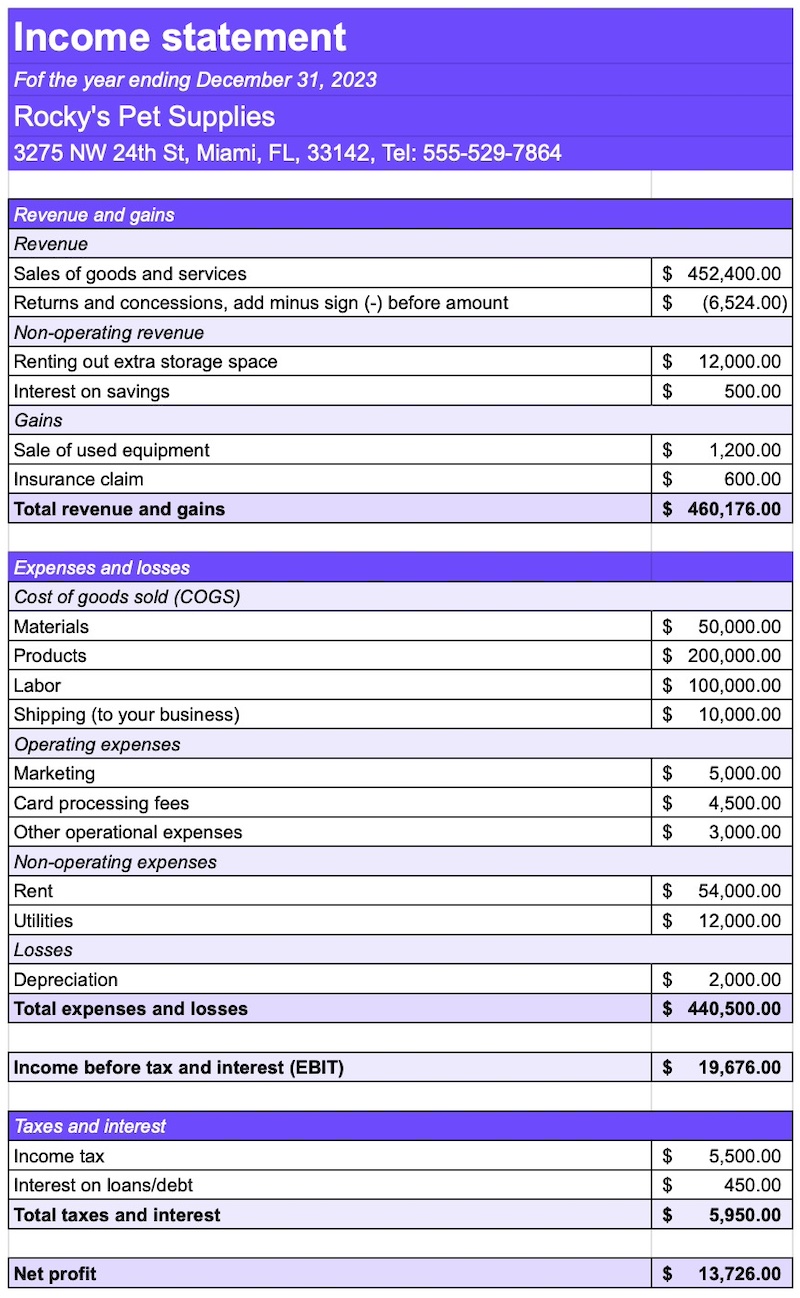
- Add up all your revenue and gains.
- Add up all your expenses and losses.
- Deduct your expenses and losses from your revenue and gains to reach your income before tax and interest (EBIT).
- Add up your tax and interest.
- Deduct tax and interest from EBIT to reach net profit.
How to create a multi-step income statement, one step at a time
The multi-step method separates operating results from non-operating results, so you can see how each part of your business performs. Follow these steps to build one:
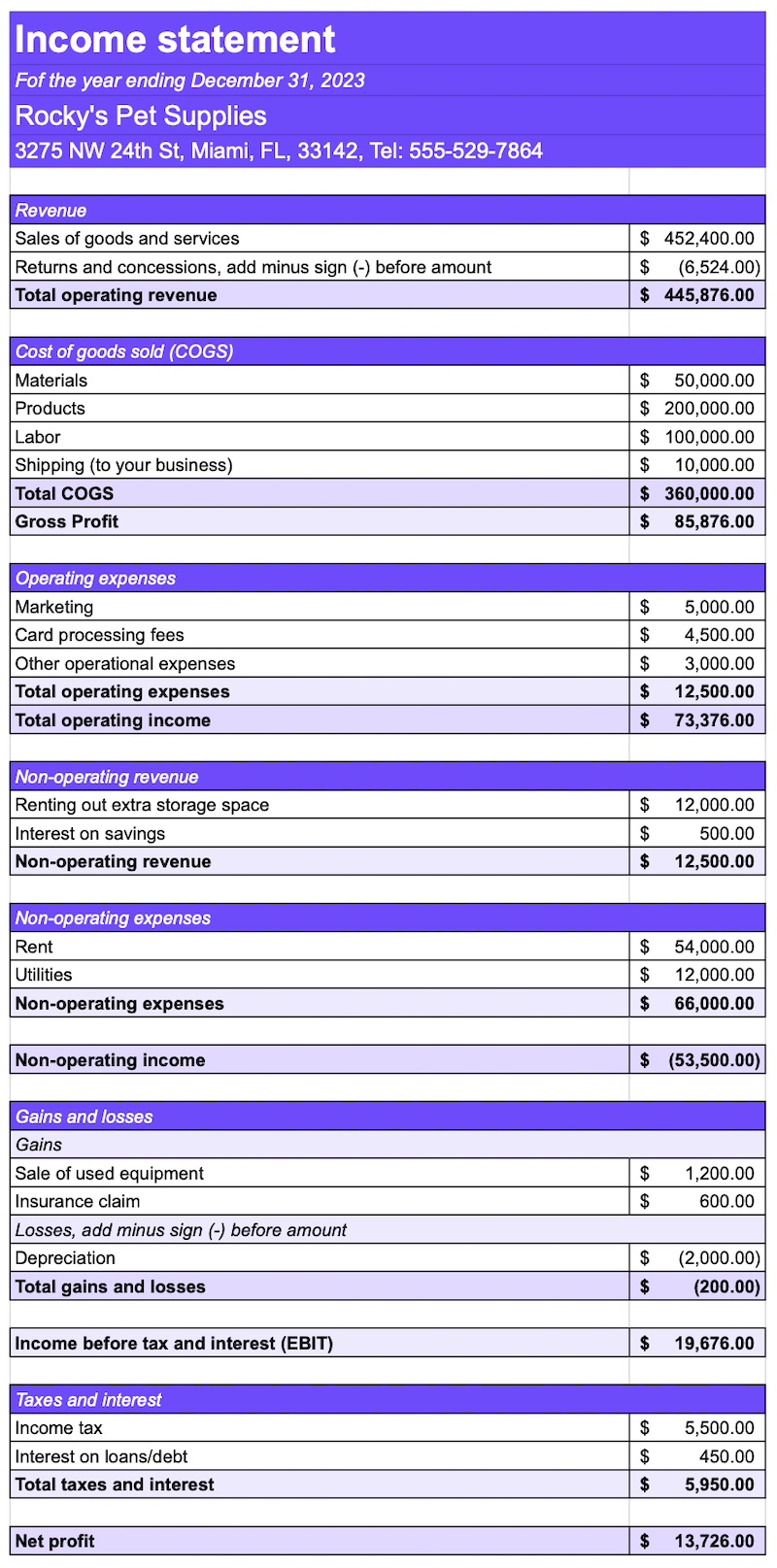
- Operating revenue. Add up all your revenue from sales during the reporting period and deduct your returns and concessions.
- Cost of goods sold (COGS). Add up all expenses directly related to the manufacturing or acquisition of goods sold or the provision of services to determine your COGS.
- Gross profit. Deduct your COGS from the operating revenue.
- Operating expenses. Add up all operating costs incurred in the reported period. Remember that this should not include COGS, which are already accounted for.
- Total operating income. Deduct the operational expenses from your gross profit.
- Non-operating revenue. Add up all income from non-core activities.
- Non-operating expenses. Add up all expenses for non-core activities.
- Non-operating income. Subtract non-operating expenses from non-operating revenue.
- Gains and losses. Add up all your gains then deduct your losses.
- Income before tax and interest (EBIT). Add gains and losses to non-operating income and operating income to reach your EBIT.
- Taxes and interest. Add up the income tax for the reporting period and the interest incurred for debt during that time.
- Net profit. Subtract the taxes and interest from your EBIT to reach net profit.
Small business income statement template
Handling financial statements can be overwhelming for anyone, especially small business owners who are more passionate about serving their customers than about spreadsheets and numbers.
To save you time, we’ve prepared an income statement template for small businesses to leverage.
It comes in a spreadsheet format (.xlsx) that you can open with Microsoft Excel, Google Sheets, or any other compatible spreadsheet program you’re used to.
In the file, you’ll find two sheets to choose from: one for a single-step income statement and the other for a multi-step statement. All you have to do is fill out your company’s information. We’ve already put in the formulas so all the calculations are done automatically.
Feel free to change the description of the items to fit your business. You can also add or delete lines as needed.
Download the free small business income statement template here.
Income statement examples
In case you’re confused, here are examples of what an income statement using both methods would look like for a pet supply store called Rocky’s Pet Supplies.
We used Melio’s income statement template to create both versions. As you can see, the numbers are the same but the way they are presented is quite different.
Example of a single-step income statement
Here’s what Rocky’s Pet Supplies’ single-step income statement for 2023 looks like.
Example of a multi-step income statement
Here’s what Rocky’s Pet Supplies’ multi-step income statement for 2023 looks like.
Keep your business organized for easy reporting
Tracking every payment in one place makes it easy to pull your expenses together at reporting time. With Melio, you can pay all your vendors digitally and keep a clear record for your next income statement.
P.S. Don’t forget to pick up our small business income statement template.
Income statement FAQs
What is the format for an income statement?
An income statement follows a top-to-bottom format. You start with revenue, subtract your costs and expenses, and end with net profit for the period.
What are the four parts of an income statement?
The four main parts are revenue, gains, expenses, and losses. Together they show how your business arrives at its net income.
What are the five components of an income statement?
Many statements break down into five components: revenue, cost of goods sold, gross profit, operating expenses, and net income.
Can you give an example of an income statement?
Yes. A simple single-step example lists total revenue, subtracts total expenses, and shows the net profit left over. You can see full single-step and multi-step examples earlier in this guide.
*This blog post is intended for informational purposes only and is not intended as financial advice.
**Melio does not provide legal, tax or accounting advice, and you should consult with a professional advisor before making any financial decisions.

What are professional services? A complete guide
Learn what professional services are, how to choose the right provider, and the easiest way to pay them.

Surviving Tax Season: A Small Business Guide to Filing and Deadlines
Prepare for tax season with confidence and file your small business taxes correctly and on time.
Why we made Small Business Season even bigger this year
During the holidays, massive players with large marketing budgets have a huge advantage over SMBs. Here’s how we attempt to level the playing field