How To Calculate Operating Cash Flow: Direct and Indirect Methods
Learn how to calculate operating cash flow using the direct and indirect methods, with a clear example.


- Key takeaways
- What is operating cash flow, and why is it important?
- How do you calculate operating cash flow?
- Operating cash flow example
- Operating cash flow vs. net income
- What is a good operating cash flow ratio?
- Best practices for calculating operating cash flow
- How Melio helps you manage cash flow
- Operating cash flow FAQs
Key takeaways
- Calculate operating cash flow with either the direct or indirect method, since both reach the same figure.
- Separate cash from profit, because net income counts earnings on paper while operating cash flow counts only cash that moves.
- Exclude investing and financing activities so your operating cash flow reflects core operations only.
- Reconcile your books with real bank transactions regularly to keep your operating cash flow accurate.
What is operating cash flow, and why is it important?
Operating cash flow (OCF) is the cash your business generates from everyday operations. You calculate it by subtracting operating expenses from revenue, then adjusting for non-cash items and working-capital changes. It shows whether a company can maintain and grow operations, and it excludes investments and interest on cash holdings.
OCF matters because it indicates how self-sustaining your business is over time, based on your normal business operations (not investments, financing, or other external funding).
It is the primary tool for determining creditworthiness, since a consistently positive and increasing OCF suggests operational sustainability while a negative one typically indicates the opposite.
How do you calculate operating cash flow?
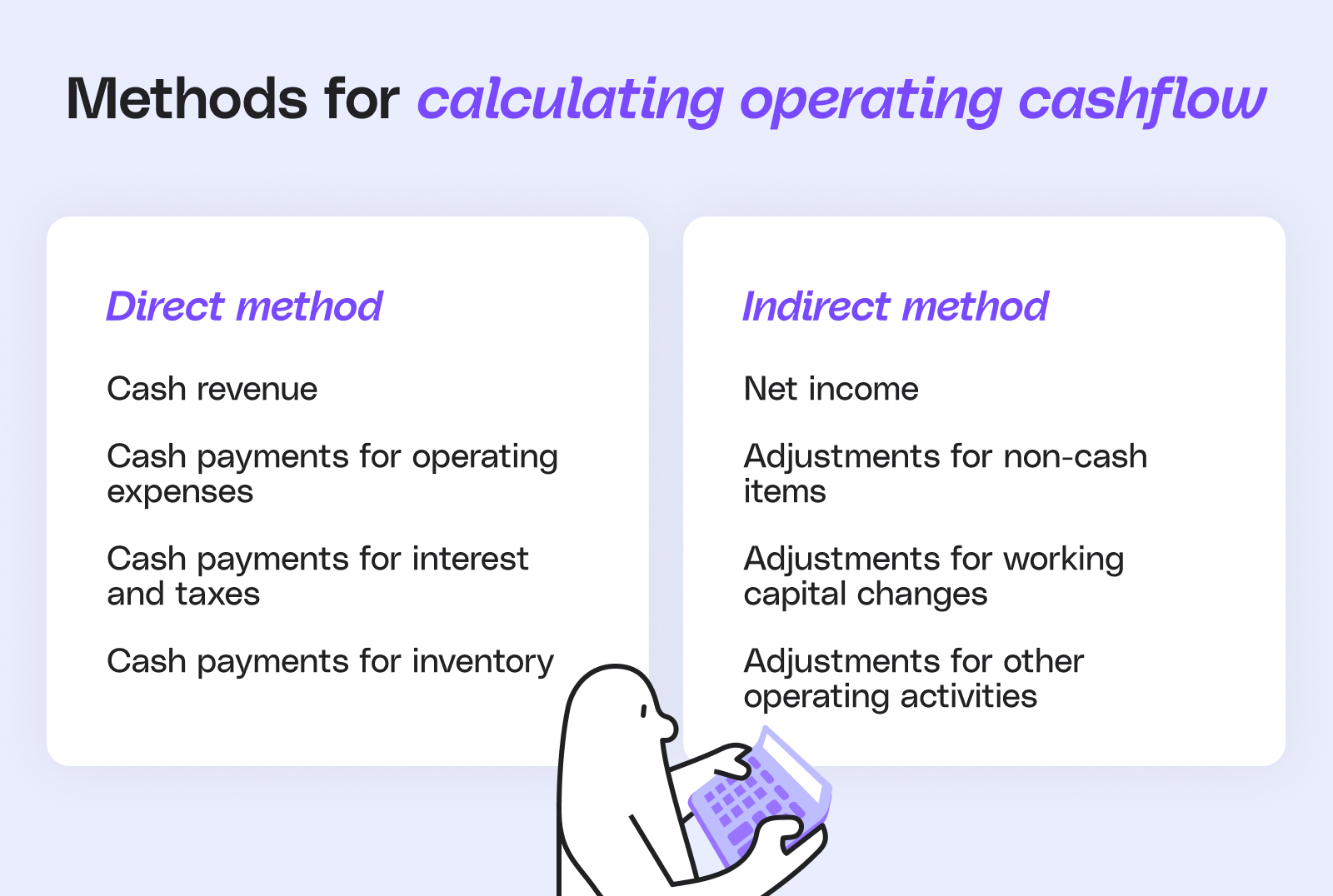
There are two standard ways to calculate OCF, direct and indirect.
Both methods produce the same operating cash flow figure. They differ only in the path they take to get there.
The direct method sums up all actual cash transactions from operations, giving you a complete view of cash movements. The indirect method starts with net income from the income statement, then adjusts for non-cash items and working-capital changes to reach the same view from another angle.
Direct method
The direct method tracks all transactions on a cash basis, showing you the actual cash inflows and outflows over a specific period. It requires detailed recordkeeping and correct segmentation of each line item to pinpoint all cash transactions related to the reporting period. It gives the most transparent view of actual cash movements, and it’s more common for small businesses because it’s harder to scale.
Cash revenue
This isn’t your full revenue figure. It’s only the cash you actually received from customers during the period. Credit sales don’t count unless the money went into your account. Payments from accounts receivable, like old invoices that were finally paid, are also included here.
Accurate tracking requires reconciliation with accounts receivable and sales records to isolate actual cash inflows.
Cash payments for operating expenses
These are the funds that physically left your accounts to cover operating costs like wages, contractor payments, materials, utilities, rent, and other day-to-day business expenses. If you recorded an expense but haven’t paid it yet, it doesn’t belong here.
This often means pulling from the cash disbursement journals or bank feeds, rather than relying only on general ledger balances.
Cash payments for interest and taxes
Under U.S. GAAP (generally accepted accounting principles), interest on loans and income tax payments are categorized under operating activities. If you’ve accrued a tax liability but haven’t paid it yet, the expense might appear on your profit and loss (P&L) statement. But until you actually make a payment, there’s no impact on operating cash flow.
Cash payments for inventory
This line only includes purchases of inventory items that were paid during the reporting period. It doesn’t matter when you placed the order. If it wasn’t paid, it’s not included.
Indirect method
The indirect method is like reverse-engineering your cash flow. Instead of listing every cash transaction, you start with your net income, your profit on paper, and then strip out all the non-cash items. From there, you adjust for changes in working capital to get to your actual cash situation. This approach is more common at large companies where going through every line item isn’t feasible.
Net income
This is your bottom-line profit, straight from the income statement (calculated using GAAP). It includes revenue earned and expenses spent, whether or not they’ve been paid.
Adjustments for non-cash items
Depreciation, amortization (spreading the cost of an asset over time), and other non-cash charges that reduce net income but didn’t affect cash in the current period are added back in.
Adjustments for working capital changes
You adjust for shifts in accounts receivable, accounts payable, inventory, and other short-term accounts that impact cash.
An increase in accounts receivable represents a cash outflow, and a decrease represents a cash inflow, as customers owe you money. An increase in accounts payable or accrued expenses indicates a deferral of cash outflow, as you owe more to suppliers and vendors.
Simply put:
- If accounts receivable went up, that’s cash not collected, so subtract it.
- If inventory went up, you spent cash stocking up, so subtract that too.
- If accounts payable went up, that’s cash not spent yet, so add it back.
Adjustments for other operating activities
Shelved tax liabilities, prepaid expenses, and non-operating gains or losses (like asset sales) are also included or excluded based on their impact on actual cash generation.
Operating cash flow example
This example shows how both methods reach the same operating cash flow figure. We start with a bakery’s income statement, then work through the direct and indirect calculations step by step.
Hypothetical income statement and balance sheet
An income statement for a small business, for example a boutique bakery, shows $500,000 in revenue, primarily from cake sales and catering services. The cost of goods sold (COGS) is $300,000, covering ingredients, packaging, and kitchen staff wages. Operating expenses total $100,000, including rent, utilities, and marketing.
Of the $100,000 in operating expenses, $20,000 is non-cash depreciation on baking equipment, and $7,000 is an increase in accrued expenses that haven’t been paid yet (such as utilities or unpaid marketing invoices). This results in an operating income of $100,000.
Applying a 25% tax rate yields $25,000 in tax expenses, producing a net income of $75,000.
On the balance sheet, year-over-year changes in working capital include:
- Accounts receivable increased by $10,000
- Inventory increased by $5,000
- Accounts payable increased by $8,000
- Accrued expenses increased by $7,000
Direct method calculation
The bakery generated $500,000 in revenue, but accounts receivable increased by $10,000, meaning only $490,000 was actually collected in cash from customers.
To calculate cash paid to suppliers, we start with the $300,000 cost of goods sold (ingredients, packaging, staff labor), adjust for the $5,000 increase in inventory (more raw materials purchased), and subtract the $8,000 increase in accounts payable (amounts not yet paid to suppliers):
$300,000 + $5,000 – $8,000 = $297,000 paid in cash to suppliers
Operating expenses include $100,000 total, but $20,000 is non-cash depreciation and $7,000 is accrued but unpaid, leaving a cash expense of $73,000.
Assuming a 25% tax rate on the $100,000 operating income, or earnings before interest and taxes (EBIT), taxes paid in cash = $25,000.
Total cash outflows:
- $297,000 to suppliers
- $73,000 in cash operating expenses
- $25,000 in tax payments = $395,000 total
Subtracting this from the $490,000 cash received from customers, we get an operating cash flow of $95,000.
Indirect method calculation
We begin with net income of $75,000.
- Add back $20,000 in depreciation (non-cash)
- Add $7,000 increase in accrued liabilities (a source of cash)
- Subtract $10,000 increase in accounts receivable (use of cash)
- Subtract $5,000 increase in inventory (use of cash)
- Add $8,000 increase in accounts payable (source of cash)
$75,000 + $20,000 + $7,000 – $10,000 – $5,000 + $8,000 = $95,000 operating cash flow
Comparison of results
Both methods calculated OCF as $95,000 in this example, and since both are simply different ways of calculating the same figure, that’s as it should be. If you calculate both and arrive at different numbers, this is likely due to errors, misclassified items, or incomplete adjustments, particularly in the indirect method where working-capital movements and non-cash items must be correctly identified.
You should cross-check and compare results to validate the accuracy of the underlying data or highlight inconsistencies.
Operating cash flow vs. net income
Operating cash flow and net income both measure performance, but they answer different questions. Net income is your accrual profit. Under the accrual method, revenue and expenses are counted when they are earned or incurred, whether or not cash has moved.
Operating cash flow counts only the cash that actually came in and went out from operations. That is why a profitable business can still run short on cash, and why a business with modest profit can hold plenty of it.
Net income is the starting point for the indirect method. Operating cash flow adjusts that figure for non-cash items and changes in working capital to show your real cash position.
What is a good operating cash flow ratio?
The operating cash flow ratio shows whether your operations generate enough cash to cover short-term bills. You calculate it by dividing operating cash flow by current liabilities.
A ratio of 1.0 or higher generally means you can pay current liabilities from operating cash alone. A ratio below 1.0 suggests you may need outside funding to cover them.
Track the ratio over time rather than reading a single number. A steady or rising ratio points to healthy, self-sustaining operations.
Best practices for calculating operating cash flow

Here’s how to keep your operating cash flow numbers clean, useful, and ready to back up your business decisions:
- Track every dollar. Maintain accurate records of all the cash moving in and out of your business, not just what’s on your income statement.
- Reconcile income statement items with real bank transactions. Accrual accounting is great, but it doesn’t tell you where your cash actually is. Reconcile income statement items with cash movement regularly to ensure consistent reporting.
- Automate what you can. Accounting software that tracks working-capital changes in real time cuts manual cleanup and reduces reconciliation errors.
- Double-check non-cash entries. Before running the indirect method, make sure things like depreciation and amortization are accurate. It’s easy to miss adjustments that throw off your final OCF.
- Use both methods. Analyze both direct and indirect methods periodically to cross-check operational efficiency and liquidity. If the numbers don’t line up, something’s off.
- Keep investing and financing out of it. Exclude cash flows related to financing (loan repayments, dividends) and investing (asset purchases) to avoid overstating OCF.
How Melio helps you manage cash flow
Operating cash flow gives you the clearest look at whether your business is actually working, day in and day out.
Melio helps you act on your operating cash flow. Schedule payments to protect your reserves, pay by card to defer outflows, and track payments in real time for accurate forecasting. Accounts receivable tools help you accelerate incoming payments, so you keep better control of cash and stay well-positioned for what’s next. Sign up for Melio to put these tools to work.
Operating cash flow FAQs
How do you calculate operating cash flow from EBIT?
Start with EBIT, add back non-cash expenses like depreciation, subtract cash taxes paid, and adjust for changes in working capital to reach operating cash flow.
What is a good operating cash flow ratio?
A ratio of 1.0 or higher is generally healthy, since it means operating cash covers your current liabilities.
What is the difference between EBITDA and operating cash flow?
EBITDA adds back interest, taxes, depreciation, and amortization to profit, while operating cash flow reflects the actual cash your operations generate after working-capital changes.
Is operating cash flow the same as free cash flow?
No. Free cash flow is operating cash flow minus capital expenditures, so it shows the cash left after reinvesting in the business.