Operating Cash Flow vs. Free Cash Flow: Key Differences
Learn how operating cash flow and free cash flow differ, and when to use each to steer smart business decisions.


- Key takeaways
- What is operating cash flow (OCF)?
- How to calculate OCF
- What is free cash flow (FCF)?
- How to calculate FCF
- What is the difference between free cash flow and operating cash flow?
- When to use OCF vs. FCF
- Free cash flow vs. operating cash flow examples
- Operating cash flow and free cash flow: keys to financial health
- Operating cash flow vs. free cash flow FAQs
Key takeaways
- Recognize that operating cash flow measures the cash your core business generates, while free cash flow subtracts capital expenditures, so FCF = OCF − CapEx.
- Track operating cash flow to confirm your daily operations can sustain the business without relying on loans to cover the basics.
- Calculate free cash flow to see how much money you have left for growth, paying down debt, or building reserves.
- Use both metrics together when you’re deciding whether to fund an expansion, since positive OCF can still leave you with thin free cash flow.
What is operating cash flow (OCF)?
Operating cash flow (OCF) is the cash your business generates from its core activities in a given period. It captures funds tied directly to what your company does: sales revenue, accounts receivable, and everyday operating expenses. Vendor payments, rent, utilities, and payroll. The stuff that shows up month after month.
What operating cash flow doesn’t include: longer-term items like investment returns or major capital purchases. Those belong in different buckets.
Why does OCF matter? It answers one critical question: can your business sustain operations on the cash it generates? If yes, you’re in decent shape. If you need loans just to cover basics, that’s a red flag.
How to calculate OCF
The straightforward version subtracts what goes out from what comes in:
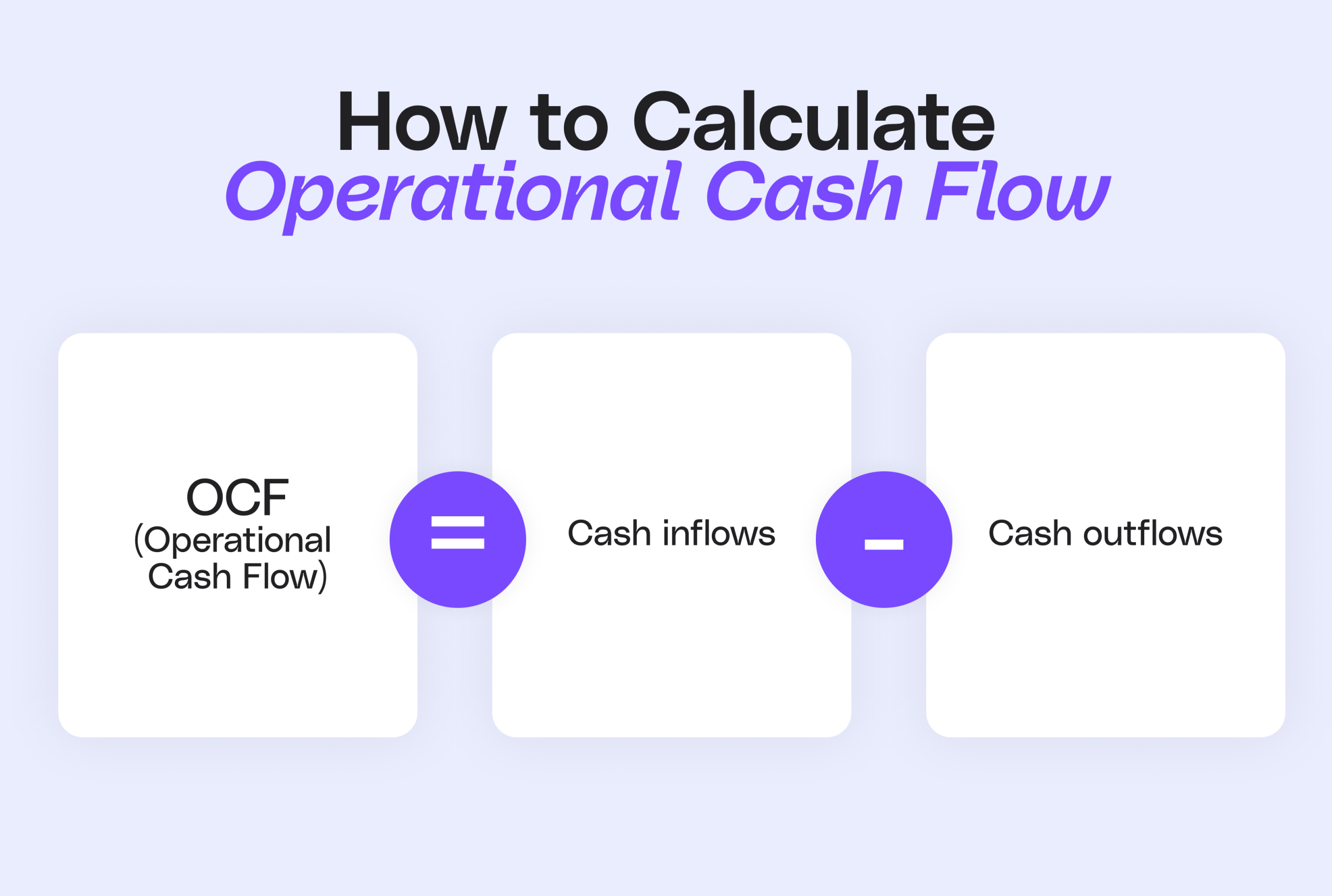
Want more precision? Start with net income, then adjust for items that affect your books but don’t represent actual cash changing hands. Depreciation and amortization (D&A) get added back since they’re accounting entries, not real money leaving your account. Then factor in changes to working capital (NWC):
OCF = Net income + D&A – NWC
What is free cash flow (FCF)?
Free cash flow (FCF) is the cash left after your business covers operating costs and capital expenditures. It’s the money available for purposes beyond keeping the lights on. Paying down debt. Funding research and development. Reinvesting in growth. Building a cushion for unexpected opportunities or problems.
Strong free cash flow signals stability and flexibility. When your cash flow forecasting shows healthy FCF numbers ahead, your business can handle surprises without scrambling for loans or outside funding. Weak free cash flow? That limits your options considerably.
How to calculate FCF
The basic formula takes your operating cash flow and subtracts capital expenditures:
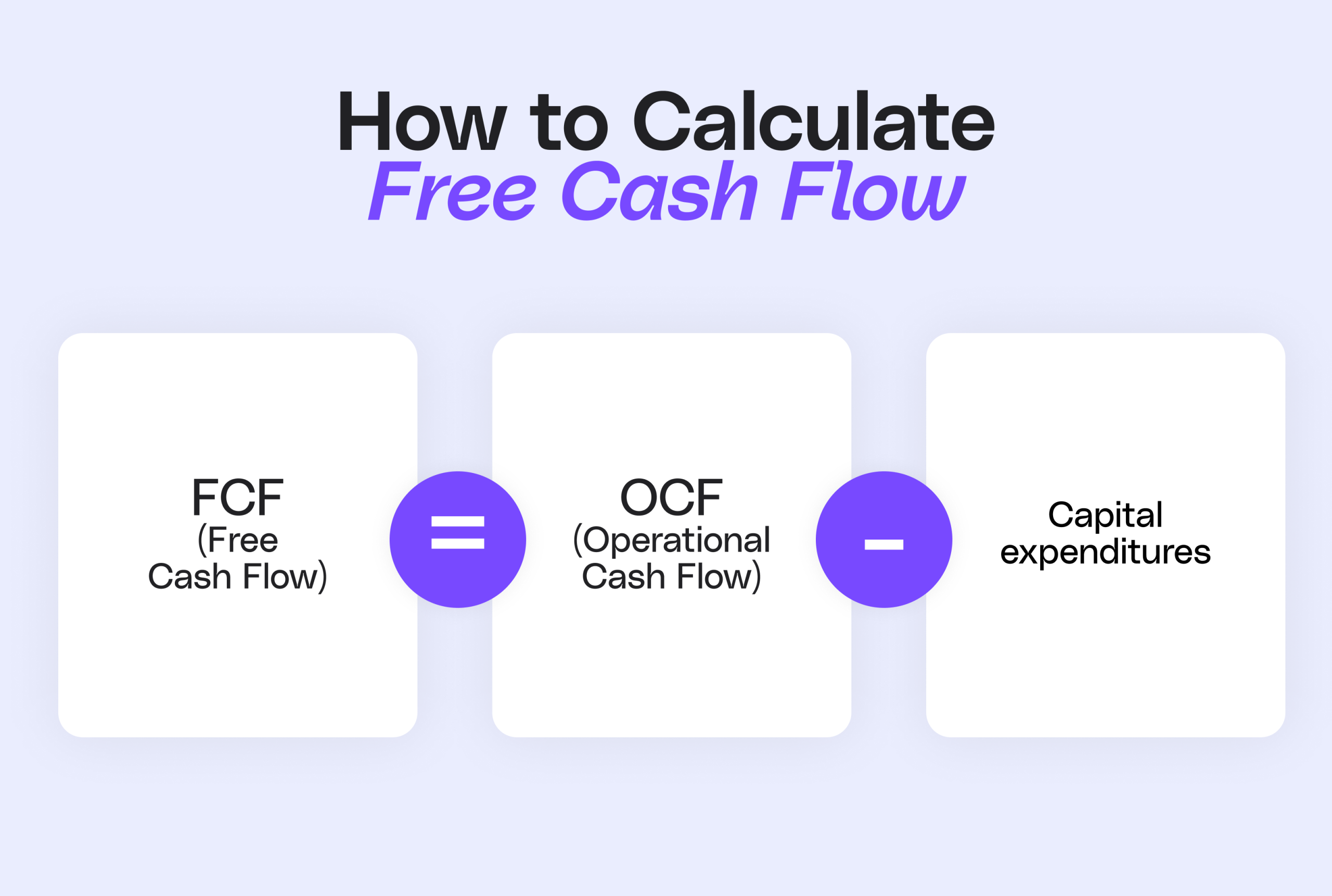
Capital expenditures cover money spent on purchasing or maintaining property, equipment, and infrastructure. The big-ticket items that keep your business functioning or help it expand.
A more detailed calculation looks like this:
FCF = Net income + Non-cash expenses − Change in working capital (NWC) − Capital expenditures
For most small and medium-sized business owners, the basic formula tells you what you need to know. Save the advanced version for when your accountant asks for it.
What is the difference between free cash flow and operating cash flow?
These terms get confused constantly, but they measure fundamentally different things.
Operating cash flow shows the money generated from running your business day to day. It ignores long-term activities like loan repayments or equipment purchases. OCF answers the question: is the core business generating enough cash to sustain itself?
Free cash flow picks up where OCF leaves off. After covering operations and capital expenditures, what remains? That leftover cash is available for discretionary decisions: expansion, debt reduction, new product development, or simply building reserves.
The dividing line is capital expenditures. Operating cash flow excludes long-term asset spending. Free cash flow subtracts it. Put simply, FCF = OCF − CapEx.
When to use OCF vs. FCF
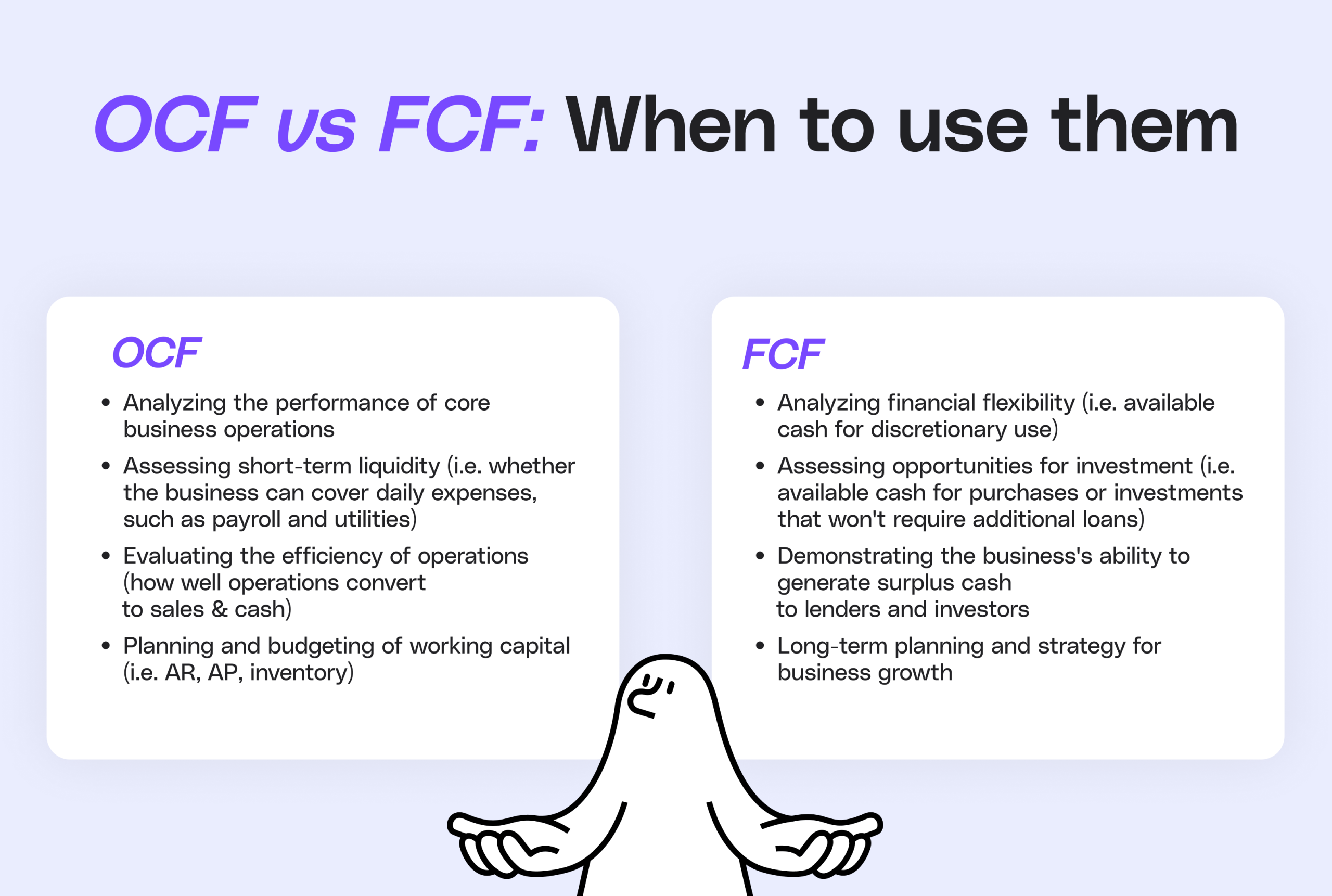
Each metric serves different purposes depending on what questions you’re trying to answer.
- Use operating cash flow when you want to know if daily operations generate enough cash to sustain the business.
- Use free cash flow when you’re deciding whether you can fund growth, pay down debt, or build reserves.
Free cash flow vs. operating cash flow examples
Numbers make this clearer. Picture a clothing store run by a small business owner.
Operating cash flow example
The store’s cash situation breaks down like this:
- Revenue from sales: $200,000
- Cost of goods sold: $50,000
- Operating expenses (rent, utilities, payroll): $40,000
The calculation:
Cash inflows ($200,000) minus cash outflows ($90,000) equals OCF of $110,000.
That $110,000 tells a good story. The clothing store covers its operational expenses comfortably and still generates surplus cash. The core business works.
Free cash flow example
Now the owner decides to expand. The store needs renovations to increase floor space, display more inventory, and attract more customers.
Operating cash flow (from above): $110,000. Capital expenditures on the renovation project: $100,000.
The calculation:
OCF ($110,000) minus CapEx ($100,000) equals FCF of $10,000.
Free cash flow lands at $10,000. Not a huge cushion, but positive nonetheless. Even after investing heavily in expansion, the business still has funds remaining. That’s a healthy sign, though the owner might want to build that buffer back up before taking on another major project.
Operating cash flow and free cash flow: keys to financial health
Now you understand what operating cash flow and free cash flow actually measure. You know how the calculations work and where these metrics diverge.
The real value comes from applying them. Whether you’re focused on improving liquidity so daily operations run smoothly, or evaluating whether you have room to reinvest in growth, these two numbers give you the clarity to make smarter decisions. Start tracking them consistently, and patterns will emerge that help you steer the business where you want it to go.
When your cash flow is healthy, paying bills and getting paid on time keeps it that way. Sign up for Melio to manage payments in one place.
Operating cash flow vs. free cash flow FAQs
How do you calculate free cash flow from operating cash flow?
You subtract capital expenditures from operating cash flow. The formula is FCF = OCF − CapEx, so free cash flow is what’s left after you cover the long-term asset spending your business needs.
What are the three types of cash flow?
Businesses track operating, investing, and financing cash flow. Together they make up the cash flow statement and show how money moves through daily operations, asset purchases, and funding activities.
Can a business have positive operating cash flow but negative free cash flow?
Yes. A business can generate healthy cash from operations and still show negative free cash flow if it spends heavily on equipment or expansion in the same period.

Is Accounts Payable an Expense? Clear Answers For SMBs
Learn how accounts payable and expenses differ, and where each one belongs in your books.

4 Ways Every Small Business Can Simplify Invoice Processing
Simplify invoice processing and pay vendors on time with a few practical digital habits.

If you use QuickBooks Online, here's why you should try Melio
Melio’s B2B payments platform syncs with QuickBooks Online so you can manage your bills, schedule payments, and improve your cash flow.