The Intentional Firm: 10 Predictions To Navigate The 2026 Accounting Landscape
Discover the 10 predictions shaping how accounting firms will grow, price, and staff in 2026.


Key takeaways
- Choose two or three shifts to focus on this year instead of chasing all ten predictions at once.
- Build repeatable advisory offerings and recurring pricing so your revenue becomes predictable and scalable.
- Govern AI and automation with clear policies and documented processes before rolling tools out to your team.
- Treat cybersecurity as a client-facing differentiator by maintaining a written information security plan.
The structural foundation
Prediction 1: Scaling plateaus require structural solutions, not just revenue growth
The 2026 prediction: Firms growing into more revenue may face predictable plateaus that feel like stagnation. The breakthrough isn’t more clients—it’s implementing structural frameworks at your firm’s appropriate size.
Why it matters: What works now won’t work when you’re larger. I’ve seen hundreds of firms hit the wall at larger revenue—every time, the owner thinks it’s a revenue problem when it’s actually a structure problem. The freedom you’re chasing through growth isn’t waiting at a larger revenue size. Bigger just means different issues to navigate. 2026’s uncertainty makes “figure it out as we go” a disaster, not a strategy.
What firms should do:
- Stop adding revenue until you fix structure – Pause new client acquisition and build scaffolding first. Easier said than done.
- Choose your ceiling deliberately – Ask “What firm do I want to lead in 2027?” not “How big should I grow?”
- Accept that freedom comes from constraints – Structure creates freedom, chaos consumes it.
Prediction 2: The 40-hour work week will no longer be a metric of capacity
The 2026 prediction: Traditional time-based capacity planning becomes obsolete. Human capacity models like the M.E.L.T. model from our book, Scale with Purpose: The Service Entrepreneur’s Guide to Intentional Growth, includes other important factors like Mind, Emotions, Location, and Time—and AI’s significant capacity gains per employee only solve Location/Time, not the human constraints.
Why it matters: Your team members aren’t the best source of information when trying to assess their capacity. Humans genuinely don’t know their own capacity. Teams are too close to their work, too worried about looking weak, etc. External oversight isn’t micromanagement, it’s a necessity. With more than 300,000 accountants gone and roughly 75% of CPAs near retirement, you can’t hire your way out—you have to manage capacity better.
What firms should do:
- Stop asking team members if they have capacity – Assign someone to own capacity distribution (preferrably a leader on your team), and use data in reports to learn what you need to know about your team’s capacity.
- Treat mind and emotions as legitimate capacity constraints – Track mental health days and recognize neurodiversity.
- Deploy AI gains toward compliance, not advisory – AI gains will come in step-like fashion. If you are focused on deploying AI into advisory, it’s too soon unless you’ve tackled teaching the full team how to leverage AI for compliance and research first.
Prediction 3: Accountability charts become retention tools
The 2026 prediction: Accountability charts showing who owns outcomes (not org charts with authority) become essential for retention.
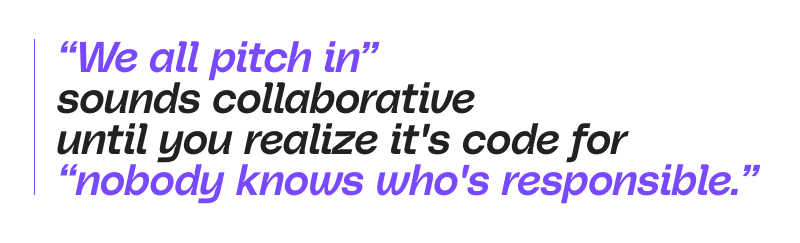
Why it matters: You’re paying a large share of someone’s salary every time they leave. With most finance leaders struggling to find replacements, you can’t afford unclear career paths. “We all pitch in” sounds collaborative until you realize it’s code for “nobody knows who’s responsible.” That burns people out faster than long hours. Virtual work after the pandemic killed ‘management by walking around’—if you can’t see people, you need systems.
What firms should do:
- Define roles by outcomes you’d fire someone for missing – Eliminates most “who should do this?” questions. Every person needs a descriptive title for their role and a Job Description.
- Update your accountability chart before announcing hires – Identify the gaps, define outcomes, then find the person to fill a specific role. Never hire into an ‘unknown’ role.
- Make your chart public and living – Update it the day someone’s role changes, whether through hires, fires, and/or promotions.

The revenue model transformation
Prediction 4: A smaller book of business will generate the larger profits
The 2026 prediction: Firms that fire their bottom 10–20% using our SARP Assessment of their client base (alignment parameters we teach are: Sustainability, Alignment, Recurrence, Profitability) see revenue increases.
Why it matters: I’ve helped dozens of firms cull their client base, and every single time revenue has increased as a result. Why? Bad clients consume capacity your best clients would pay premium rates to access. Niche firms often report meaningfully higher net revenue per client—you can serve half as many clients and make more money. Yet niching can get you into trouble if your niche is focused in the wrong market.
What firms should do:
- Fire your bottom 10–20% of clients this year – Bad clients consume disproportionate capacity. Firing the bottom 10–20% relieves your team’s capacity to be re-deployed to better clients. We keep every client on a renewing agreement for 12 month or less so that when it comes time to renew, we simply choose not to renew with those particular clients. Sometimes we’ll deliver this message over a Zoom meeting or phone call, and sometimes through a simple email.
- Niche carefully – Niching is a strategy of claiming expertise in the market you serve, yet you have to make sure the market you are niched in will pay higher prices. From our own example, we have served large digital marketing and design agencies for years. As this industry faces the competition of AI, we have needed to broaden our positioning to “We Serve Entrepreneurs,” even those outside of the agency niche. It’s time to consider your niches and which ones will continue to work for your firm.
- Don’t be afraid of price increases – Increase your prices 5–10% (depending on the firm) over time. We’re all in an inflationary period so a price increase is a normal strategy we must all consider right now.


Prediction 5: Advisory services overtake compliance as primary revenue driver
The 2026 prediction: CAS (client accounting services) and other types of advisory remain essential for competitive positioning. This is the year advisory practices become mainstream and CAS becomes a main revenue driver. Firms must develop repeatable advisory offerings using frameworks and processes for how the team delivers advisory.
Why it matters: Advisory practices are growing while compliance revenue stays flat. If you’re betting on tax returns and compilations, you’re betting on a shrinking market. Many CAS firms have already figured out that hourly billing doesn’t work for advisory, so they are switching to fixed pricing. Firms with formal CAS plans report higher revenue per client because they’ve built systems to deliver that CAS. Advisory delivered ad hoc is consulting and harder to scale. CAS delivered systematically is a business.
What firms should do:
- Build advisory processes before you’re good at advisory – Document your first 3 engagements into a repeatable process.
- Price advisory higher than you’re comfortable with – Try to price higher than what feels “fair” to you, and make sure you are not only selling what the founder can deliver. The team needs to be part of this service delivery. Pricing technical professional services should be pursued from the vantage point of value, not how you personally feel.
- Bundle advisory with compliance – Both of these services are still being purchased by our clients, so keep them together. But adjust your fixed price package to lead with the advice you are selling.
Prediction 6: Hourly billing will be labeled a high-risk business model
The 2026 prediction: Building on prediction 5, firms will shift from project-based and time-based billing to recurring revenue models. Monthly retainers and advisory packages become the foundation of predictable, scalable revenue.
Why it matters: Recurring revenue is how you build a valuable firm. One-time projects create revenue volatility. While one-time project revenue is necessary, you’re constantly hunting for next month’s billings. Advisory practices with recurring models report higher monthly revenue and higher firm valuations when it’s time to sell or bring in partners. Clients prefer predictability too, and many prefer fixed fees. Monthly recurring revenue lets you plan capacity, hire strategically, and stop living month-to-month.
What firms should do:
- Convert your best clients to monthly retainers first – Start with clients that trust you, are already getting advisory work, and package it as a subscription. One way to add value is to offer more face-to-face meetings, or to increase the recurrence of your service delivery.
- Build tiered subscription packages – Create good, better, and best monthly offerings that include compliance and advisory. Most clients pick the middle option, so be aware of how you construct your options.
- Track MRR (Monthly Recurring Revenue) as your primary metric – Shift focus from annual revenue to predictable monthly base revenue so you can compare it against your firm’s average operating expenditures.

The capability multipliers
Prediction 7: Only proper governance will make AI your real second brain
The 2026 prediction: AI adoption only increases as a competitive necessity, but there will be more focus on doing it properly and safely. AI conversations will focus heavily on strong governance policy, best practices, and a new role of internal AI Champion.
Why it matters: AI adoption among firms has climbed sharply in the past year. Firms with clear AI strategies are far more likely to see benefits, while firms without plans risk falling behind within a few years. AI creates better and faster thinking and research, but it doesn’t fix burnout or build resilience. AI is just the required table stakes as we move into 2026.
What firms should do:
- Oversee AI use with governance – Don’t dump AI tools onto your team without the principles and policies by which you’ll oversee it. In our firm, we run an “AI Learning Lab” in the last week of each month’s team meeting so we can learn from each other.
- Measure time saved, not accuracy improved – Over 2026, we’ll see efficiencies gained with AI, so make sure you can track how much is being saved.
- Make AI training mandatory, not optional – Require monthly or quarterly skill-building for everyone. AI takes practice to use because it challenges professionals to do their work differently.
Prediction 8: Automation strategy separates winners from losers
The 2026 prediction: While technology-mature firms earn notably more revenue per employee, a large share of automation projects fail due to poor execution. The winners won’t be defined by the tools they buy, but by their discipline in documenting processes before automating and consolidating into integrated platforms rather than collecting disconnected apps.
Why it matters: Few firms have successfully implemented automation, even though most agree it improves efficiency. The gap between “we bought the tools” and “we’re getting value” is massive. Projects fail when firms skip process documentation, underestimate implementation timelines (think 2–6 months, not 2–6 weeks), and don’t budget for change management. Integration beats individual tool quality every single time.
What firms should do:
- Document every process before you automate anything – If you can’t hand a written workflow to a new hire and watch them execute it perfectly, you’re not ready to automate. Spend most of your effort on documentation and the rest on tool selection.
- Consolidate down to 5–7 integrated platforms – Make plans to leave disconnected tools behind, even if they’re “better” standalone. Fragmentation still costs more than feature gaps in the software you pick.
- Budget for change management, not just software – Take time to consider your purchases, then devote part of your budget to the change management that will be necessary. We suggest spending at least 3 to 4 months to review at a minimum 2 (or more) new potential tools. Always choose from a choice of 2 or more.
Prediction 9: Alternative team structures go mainstream
The 2026 prediction: A growing majority of firms will embrace offshore, contract, or fractional staffing. Hybrid models (a core local team plus flexible offshore capacity) will allow small firms to offer large-firm service breadth.
Why it matters: The math is brutal. More than 300,000 accountants have left, roughly 75% of current CPAs are near retirement, and most finance leaders can’t find qualified people. The “full-time local employee” model is fading, and many are exploring alternative team structures. Offshore isn’t about cost savings anymore (though lower costs help). It’s about accessing capacity that doesn’t exist in the US market. The Wall Street Journal and the AICPA have documented this shortage.
What firms should do:
- Consider outsourcing your highest-volume work – Give offshore your most process-driven work, and keep strategic work local if you can. This will take time to practice and implement, so be patient.
- Treat offshore team members exactly like local staff – No separate org chart or different standards. Firms are learning to make the outsourced team part of the overall team.
- Require perfect process documentation before your first hire – If a local new hire can’t execute it perfectly from your docs, you’re not ready. Distance and different work hours make it harder for the outsourced team to get what they need, so drive their work with processes.
The risk management essentials
Prediction 10: Cybersecurity compliance becomes a differentiator
The 2026 prediction: The FTC Safeguards Rule makes Written Information Security Plans (WISP) mandatory for all tax preparers in the US, with steep penalties for non-compliance. Forward-thinking firms position data protection as a client service differentiator. The IRS outlines what a compliant plan must include.
Why it matters: With exposure breaches increasing at an alarming rate (especially with the help of AI), exposure isn’t theoretical. Cybersecurity has ranked among the top risks facing firms for years because it is so often ignored. Cloud tools, offshore teams, and AI all increase your attack surface. “We’re too small to be a target” died when you moved to the cloud. It’s becoming important to have a role that oversees this critical aspect of your firm.
What firms should do:
- Assume you’ll be breached, not if but when – Build breach response protocols assuming attackers get in. You need a response protocol for your team and client base.
- Make clients sign security acknowledgment agreements – Shift from “we’ll protect you” to transparent, shared accountability with the client. Clients need to see you are making security a serious issue in 2026.
- Market your security as a premium service feature – Advertise your measures so your current clients (and new ones) can feel comfortable knowing you are taking this seriously.

The path forward: choosing intention over reaction
These 10 predictions aren’t a to-do list—they’re a landscape map. The firms that thrive won’t tackle all 10 simultaneously. The strategy is to choose 2–3 to go all-in on in 2026.
Here’s what matters: becoming an intentional firm, not a reactive one. The landscape is getting more competitive. AI is accelerating, talent is scarce, clients demand more, and margins are tightening. You can’t accidentally stumble into a well-run firm anymore. You have to build it on purpose.
The structural foundation (Predictions 1–3) enables everything else. The revenue model (Predictions 4–6) determines whether you’re building something valuable or just staying busy. The capability multipliers (Predictions 7–9) give you leverage. Security (Prediction 10) protects it all.
Pick your 2–3 based on where you’re stuck. Hitting a growth ceiling? Start with structure. Revenue flat? Fix your revenue model. Capacity constraints? Focus on multipliers.
The question isn’t whether these changes are coming, it’s whether you’ll lead them intentionally or react when the market forces your hand.
Ready to make bill pay one less thing to manage as you build your firm of the future? Sign up for Melio and give your team a faster, more secure way to pay and get paid.
Jason Blumer is the Founder and CEO of Thriveal, a community focused on helping CPA firm owners build intentional, scalable firms. He also runs his firm Blumer CPAs.
Accounting predictions FAQs
Will AI replace accountants?
AI is automating routine accounting tasks, but it is not replacing accountants. The role is shifting toward advisory work, judgment, and oversight that AI cannot do on its own.
Why is there a CPA shortage?
Fewer graduates are entering the field while a large share of current CPAs approach retirement. That gap is pushing firms toward automation, offshore capacity, and stronger retention.
Is accounting still a good career in 2026?
Yes. The U.S. Bureau of Labor Statistics projects accountant and auditor jobs to grow 5% from 2024 to 2034, and the role is becoming more strategic.

How to Build a Marketing Plan for Your Small Business
Learn how to build a marketing plan that helps your small business attract customers and grow.

How Accountants Can Make The Most Out Of Cloud Accounting
Discover how cloud accounting helps accountants save time, protect client data, and grow their practice.

6 Accounts Receivable Metrics Small Businesses Should Track
Track the right accounts receivable metrics to get paid faster and keep your cash flow healthy.