How To Price Your Accounting Services: 2026 Rates And Model Guide
Set profitable rates with confidence using clear pricing models, benchmarks, and proven value strategies.


- Key takeaways
- How to price accounting services
- What factors affect how you price accounting services
- How much do accountants charge?
- Value-based pricing and putting it to work
- Communicating value (without sounding salesy)
- A quick note on the “quick question”
- Testing the advisory waters (without breaking your business)
- Price for value, then free up time to deliver it
- Accounting services pricing FAQs
Key takeaways
- Match your pricing model to the work, using fixed fees for compliance, value-based pricing for advisory, and hybrids where they fit.
- Base your rates on real factors like costs, cash flow, location, your target client, and your expertise, not guesswork.
- Price advisory work on the value and results you create, then explain that value in terms of client outcomes.
- Review your pricing at least once a year so your fees keep pace with rising costs and your growing expertise.
How to price accounting services
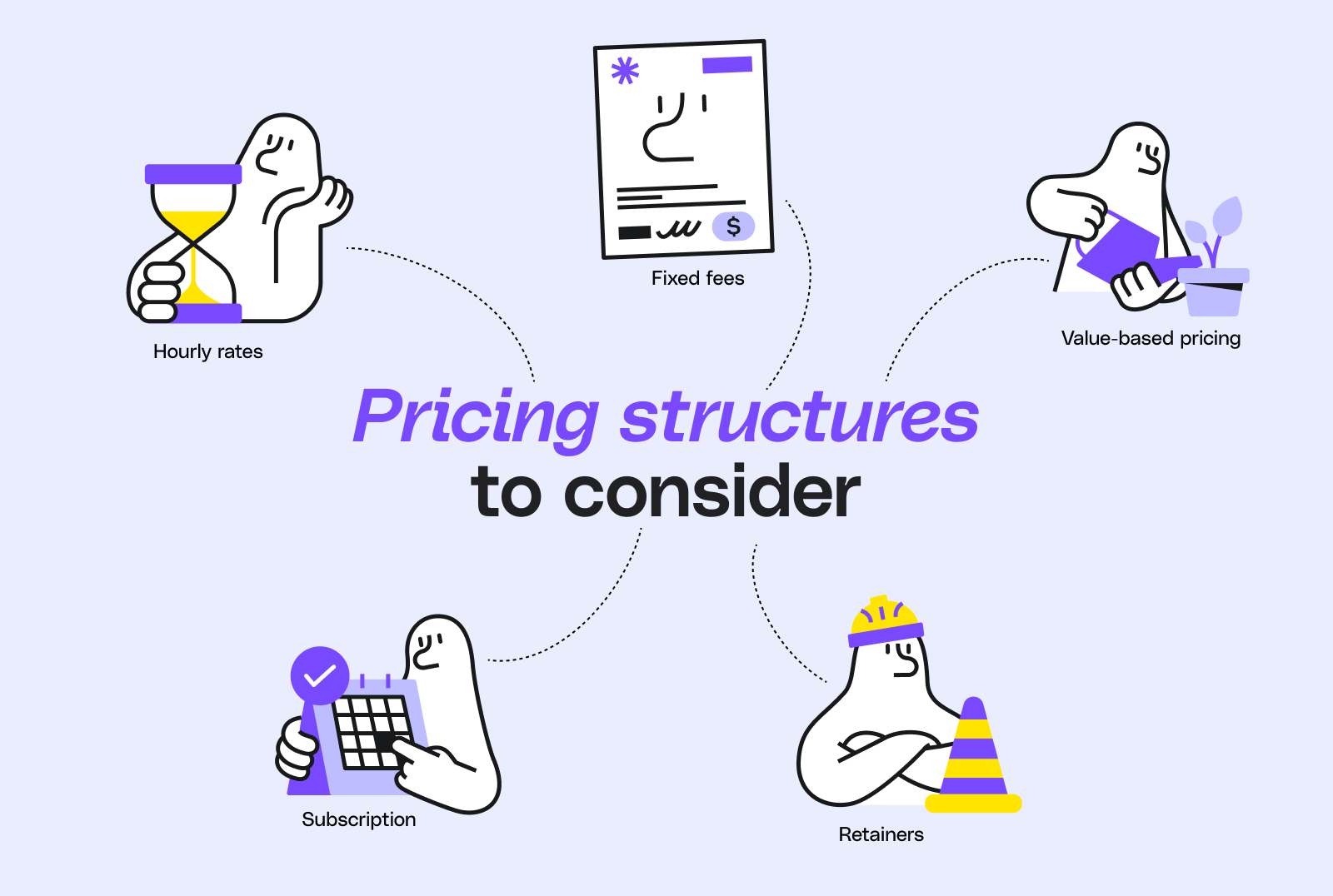
You’re probably familiar with these pricing approaches but it’s worth revisiting them with today’s client expectations in mind. Each model has its place, and understanding their strengths helps you build the right mix for your practice.
- Hourly rates: The traditional approach, which is mostly avoided these days. Simple to explain, but potentially punishes efficiency and creates uncertainty for clients. Still useful for unpredictable work, but increasingly out of favor. Clients don’t know what their bill is until they get it, possibly eliciting shock and general dissatisfaction. Not a roulette many like to spin.
- Fixed fees: Set prices for defined deliverables. Clients love the predictability of fixed fee accounting, and you benefit when automation increases your efficiency. An ideal option for routine compliance services that you’ve systematized.
- Value-based pricing: The fee reflects the value delivered, not time spent. When you save a client $35,000 in tax, charging $3,500 feels like a bargain to them, even if automation helped you do it in half the time.
- Retainers: Regular monthly payments for ongoing services. Creates stable cash flow and encourages deeper client relationships. Often structured as tiered packages (Compliance, Insights, Advisory).
- Subscription: Subscription pricing also works well for low-cost, DIY accounting services by offering clients affordable, ongoing access to software and basic support. It creates predictable revenue for firms while empowering clients to manage routine tasks themselves, and provides a natural pathway to upsell as clients’ needs evolve.
The best approach? Typically, a hybrid. You could use fixed fees for predictable compliance work, value-based for advisory, and subscriptions for those DIY entry-level relationships.
What factors affect how you price accounting services
Before you land on a number, look at what actually shapes it. A few factors matter most.
- Your costs and target margin: your rates need to cover software, salaries, and overhead, then leave room for profit.
- Cash flow: fixed fees and retainers let you bill in advance, which smooths out income.
- Your location and market: what clients expect to pay varies by region and industry.
- Your target client: a startup and an established company have different needs and budgets.
- Your experience and niche: deeper expertise and specialization justify higher rates.
When you can point to these factors, you can explain your price with confidence instead of guessing.
How much do accountants charge?
There’s no single right number, and rates vary widely by service, scope, and region. Most firms price one of three ways.
- Hourly: straightforward, but it ties your income to time spent.
- Fixed fee: a set price for a defined service, so clients know the cost upfront.
- Value-based: a fee tied to the results you deliver.
Use published benchmarks as a sanity check, not a ceiling. What matters most is that your price reflects your costs, your market, and the value you create.
Value-based pricing and putting it to work
This is the big one when it comes to how to price accounting services, so let’s talk about it.
We all hear “value should drive pricing!”. It’s not a new concept. Switching to value-based pricing aligns your incentives with your clients’ success, creates stronger relationships, and can boost profitability.
It seems simple: charge based on the value you create, not the time you spend.
The hang-up isn’t understanding that part, it’s actually implementing it in your practice.
Especially when you’re trying to make the shift towards advisory and business insights services. Advisory is now the norm: Wolters Kluwer reports 93% of firms offer advisory services, up from 83% a year earlier. And CPA.com’s 2024 CAS Benchmark survey found that firms earning significant revenue from higher-level business insights advisory services report more than 30% higher monthly recurring revenue.
Here are some ways to think about it:
What’s the value exchange? When your client pays you $2,000 and receives $20,000 in tax savings, that’s a 10x return on their investment. Your fee then, isn’t based on whether it took you 15 hours or 5 hours, but on the percentage of value you helped create. You might consider charging 20–30% of the tax savings you generate. So, a $50,000 tax saving could warrant a $10,000–15,000 fee, regardless of how long it took.
How does your work impact the business? Consider how much your work affects their bottom line. Financial reporting that helps secure a $500,000 loan should be worth more than the same reports used just for compliance. Same work, different value. For growth consulting, you might develop packages ranging from $15,000–$50,000 for creating three-year financial roadmaps with pricing based on the potential impact, not your time investment.
What risks are you helping clients avoid? There’s real value in the risks you help clients avoid. Preventing a $50,000 tax penalty or identifying fraud before it reaches $100,000 has tangible value you can capture in your pricing. If you have specialized compliance expertise in areas like cybersecurity or industry regulations, you could command premiums of $10,000+ for projects where your knowledge significantly reduces client risk.
What opportunities are you creating? Advisory often creates opportunities that wouldn’t exist otherwise. When you spot a new market opportunity or cost-saving measure through data analysis, that’s measurable value you’ve generated. For technology implementation, you might charge $5,000–$20,000 based on the efficiency gains the client will receive (like reducing 20 hours of monthly work to 5 hours), not how long the setup takes.
How much is peace of mind worth? Don’t underestimate the value of reassurance. For many business owners, simply knowing their finances are in expert hands has substantial value they’re willing to pay for. When supporting clients through major transactions like acquisitions, you might consider fees of 1–2% of the transaction value. The more valuable and complex the deal, the more you’d earn.
Communicating value (without sounding salesy)
If value-based pricing is the what, this is the how. For many accountants, this part can feel foreign at best and wildly uncomfortable at worst. But if you believe in the value of what you’re offering (you know it will make a meaningful difference for your client) then communicating it clearly and candidly isn’t salesy. It’s service.
Lead with their goals.
Ask open questions like: “What’s your biggest financial challenge right now?” Understanding their pain points creates natural openings to talk about how you can help.
Focus on outcomes.
“Our monthly financial review has helped similar businesses improve profitability by 15% on average.”
Use real examples.
“When we helped XYZ Company implement payment automation, they reduced late payments by 60% and freed up 10 hours of staff time every week.” Specifics sell because they’re relatable.
Offer a comparison that puts your value in context.
“Our premium package costs roughly half what you’d pay for a part-time finance director but gives you access to our entire team’s expertise.”

A quick note on the “quick question”
We’ve all experienced it. The client who emails or calls with “just a quick question” that’s never actually quick. It’s a tough one: they’re a paying client and you obviously want to help. But remember that your “quick answer” comes from years of education and experience. It has value! From onboarding, set clear boundaries about what’s included in your base fee and what can trigger additional charges so clients know from the get-go.
Testing the advisory waters (without breaking your business)
Understanding value is one thing. Pricing for it is another. How do you start offering advisory in a way that’s sustainable, profitable, and actually lands with clients?
We’re not overhauling your firm overnight. We’re layering advisory into what you already do, deliberately, with the right clients, and with clear positioning.
Start here:
Start with your believers: Begin with clients who already trust you. Find one specific advisory opportunity in their financial data and present it as a standalone project with a value-based fee. Don’t try to convert your most skeptical clients right out of the gate.
Pilot, learn, and iterate: Treat your first few advisory projects as experiments. Test your pricing, gather feedback, and don’t be afraid to adjust your approach as you go. Advisory is a journey, not a one-off event. After each engagement, ask clients what worked, what didn’t, and what they’d pay for next time. Their insights will help you refine your services and pricing for future clients.
Talk about specific outcomes: Try framing each advisory service in terms of what success might look like with actual numbers. Instead of just offering “cash flow forecasting,” you could say something like, “This cashflow forecast will help you reduce inventory costs by around 15%.” Clients tend to respond better when they can visualize concrete outcomes rather than just hear the names of services.
Create good-better-best options: Tiered pricing isn’t new, but it’s still an effective way to introduce advisory services. The key is to make each option outcome-focused and relevant to your client’s goals, not just a menu of tasks to pick and choose from. Most clients will pick the middle tier, so design that as your sweet spot. For even more flexibility, consider modular add-ons or a la carte advisory sessions that let clients build their own package as their needs grow.
Build your evidence file: Document everything when you deliver value. The retailer whose profitability jumped by $20,000 after implementing your inventory recommendations becomes your proof for future clients. Nothing sells value like evidence.
Pricing isn’t a set-it-and-forget-it deal. Best practices for how to price accounting services will always evolve. Costs go up, your expertise grows, and the market keeps moving. Most firms give their pricing a health check at least once a year. Some even do it every six months, especially when inflation or tech costs start creeping in. Just don’t spring pricing surprises on those you serve. Give clients a heads-up, explain the “why” behind any changes, and tie it back to the extra value you’re delivering. Regular reviews keep your fees fair, your profits healthy, and your practice future-proofed.
Price for value, then free up time to deliver it
The firms that price well also protect their time. Automating routine bill pay and invoicing clears hours you can reinvest in the advisory work clients happily pay a premium for. Sign up for Melio to simplify how your firm pays and gets paid.
Accounting services pricing FAQs
How do you bill clients for accounting services?
Set the model and terms upfront, then invoice on a clear schedule. Fixed fees and retainers are usually billed in advance, hourly work in arrears, and value-based work at agreed milestones.
How do you tell a client you’re raising your prices?
Give plenty of notice, explain the reason simply, and tie the change to the value you deliver. Framing options as tiers makes the conversation easier.
How often should accountants review their pricing?
At least once a year. Review more often when your costs, expertise, or the market shift, so your fees stay fair and profitable.
*This guide is intended for informational purposes only and is not intended as financial advice.
**Melio does not provide legal, tax or accounting advice, and you should consult with a professional advisor before making any financial decisions.