What Is Net Cash Flow? How It’s Calculated And Why It Matters
See what net cash flow is, how to calculate it, and what your number reveals about your business.


Key takeaways
- Calculate net cash flow by subtracting your total cash outflows from your total cash inflows over a set period.
- Track your net cash flow across operating, investing, and financing activities to see the full picture of your money.
- Recognize that positive cash flow is not the same as profit, since borrowed money can inflate your number.
- Compare net cash flow with net income to understand both your liquidity and your long-term profitability.
What is net cash flow?
Net cash flow is the difference between the money coming into your business and the money going out over a set period. If more cash enters than exits, your net cash flow is positive. If more leaves, it’s negative.
You’ll find this number on your cash flow statement. It tells you whether your business can cover short-term expenses and meet financial obligations right now. Track it across multiple periods, and patterns emerge that reveal something deeper about your company’s stability and long-term viability.
Net cash flow components
Three categories of business activity feed into your net cash flow:
- Operating activities: cash from your core business operations.
- Investing activities: cash from buying or selling long-term assets.
- Financing activities: cash exchanged with owners and creditors.
Together they show the complete picture of cash moving through your business.
Cash flow from operating activities
This is the bread and butter. Operating cash flow tracks the money tied to your core business functions: the revenue you generate from actually doing what your company does. These numbers pull from your income statement along with adjustments for things that affect working capital.
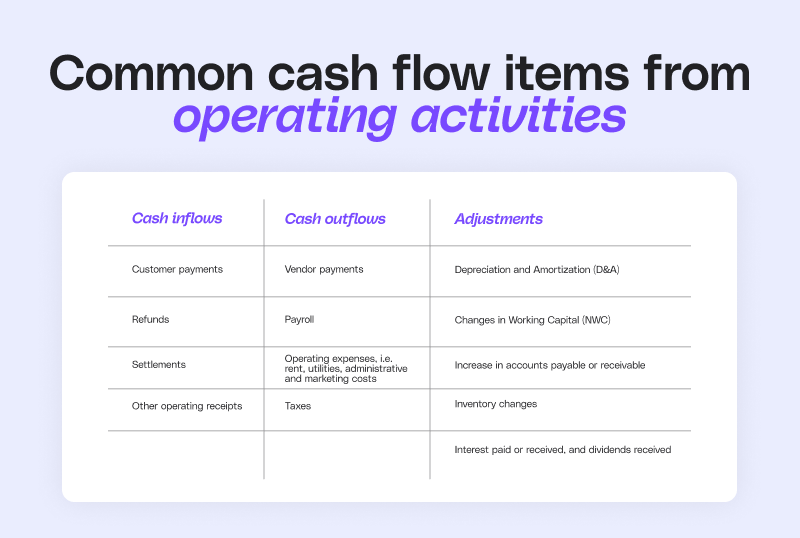
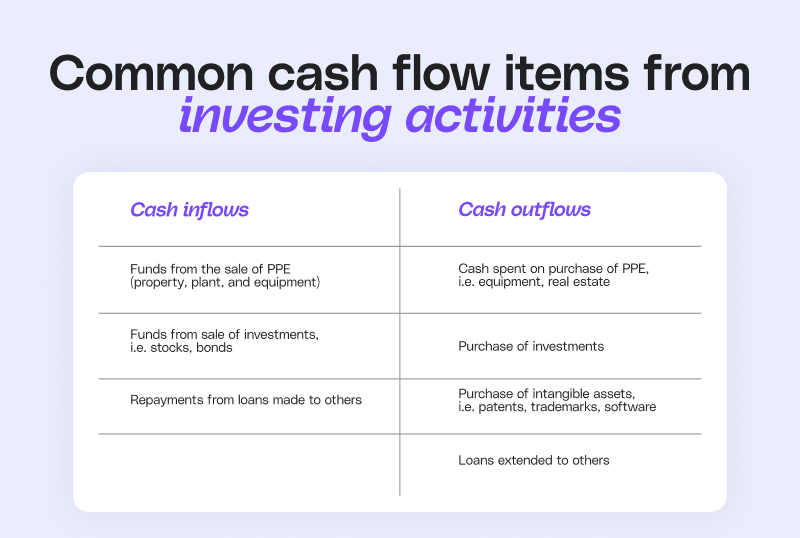
Cash flow from investing activities
Investing cash flow captures money related to buying or selling long-term assets and investments. The direction of this flow tells a story. When outflows exceed inflows, the company is likely investing in growth, purchasing equipment, acquiring property, or buying into other opportunities. When inflows exceed outflows, assets are being sold off or liquidated.
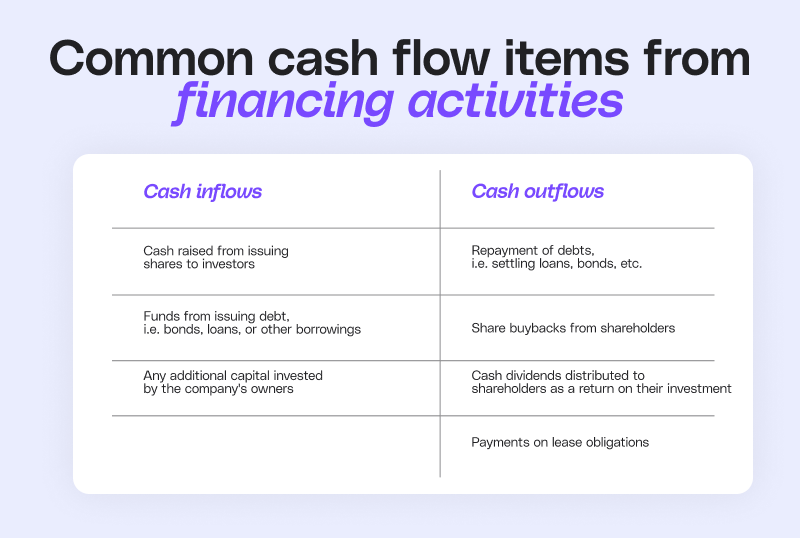
Cash flow from financing activities
Financing activities track cash transactions between your company and its owners or creditors. This category shows how a business raises capital and how it returns value to stakeholders. For freelancers and smaller operations, financing activities matter less day to day. Still worth understanding how this piece fits into the overall cash flow puzzle.
How to calculate net cash flow
To calculate net cash flow, subtract total cash outflows from total cash inflows. The math is simple: cash in, minus cash out.
Say your business brings in $50,000 and spends $30,000. Your net cash flow is $20,000.
For a full annual view, add the cash flow from all three activity types. Example: $60,000 operating, plus $30,000 investing, plus $20,000 financing, equals $110,000 total net cash flow.
Net cash flow formula
The basic version:
NCF = Cash inflows – Cash outflows
The extended version:
NCF = Cash flow from operations (CFO) + Cash flow from investing (CFI) + Cash flow from financing (CFF)
Positive vs. negative cash flow
Two possibilities exist here. Positive cash flow means more money entered your business than left it during a given period. Negative cash flow means the reverse: you spent more than you brought in.
Positive cash flow puts you in a comfortable position. Enough money on hand to cover operational expenses. Room to invest in growth. A cushion for unexpected costs that inevitably pop up.
Here’s where it gets interesting, though. Cash flow and profit aren’t the same thing. A company can show positive cash flow simply because it just secured a loan, even while sales remain too weak to generate actual profit. The cash is there, but it’s borrowed cash.
Negative cash flow sounds alarming, and sometimes it should be. But context matters. Growing businesses often spend heavily on equipment, hiring, and expansion. That spending creates temporary negative cash flow. Once sales catch up, positive cash flow returns.
Still, don’t brush off negative cash flow without investigating. It frequently signals real problems: operational expenses that have ballooned out of control, sales that have slumped, customers who aren’t paying on time. When you spot negative cash flow, start by examining the relationship between what you owe and what others owe you.
Net cash flow vs. net income
These two metrics measure different things, and both matter for understanding your financial health.
Net cash flow tracks actual money moving in and out over a specific timeframe. It reveals liquidity and shows whether your business can generate and manage cash effectively. This information lives on your cash flow statement.
Net income measures profit. It’s what remains after subtracting expenses, taxes, and costs from revenue. Net income demonstrates profitability over time, but it doesn’t always move in sync with cash flow. A company can be profitable on paper while struggling with negative cash flow. The reverse happens too: positive cash flow with no real profit underneath.
Net income appears on your income statement. Combine that with your balance sheet and cash flow statement, and you get a much fuller view of liquidity, profitability, and whether the business can sustain itself.
The importance of net cash flow
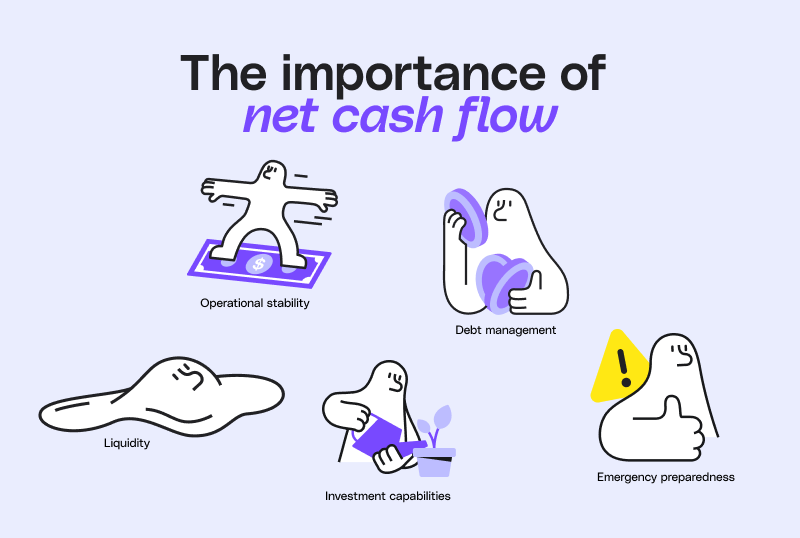
Net cash flow serves as a diagnostic tool for your business’s financial condition. It informs critical decisions across several areas.
Liquidity: shows whether you can cover daily expenses and meet obligations with cash on hand.
Operational stability: shows whether your core activities generate enough cash to keep the business running.
Investment capabilities: show whether cash is available to reinvest in growth, buy equipment, or develop new products.
Debt management: shows whether you can repay loans and interest when they come due.
Emergency preparedness: shows whether you have reserves to handle unexpected problems.
What are the limitations of net cash flow?
Net cash flow matters, but it doesn’t tell the whole story by itself.
Positive cash flow doesn’t automatically mean profitability. That cash might come from borrowing or selling off assets rather than generating revenue through actual business operations. Net cash flow also ignores non-cash transactions like depreciation or accrued expenses, which can distort the picture of how you’re really performing financially.
And here’s the big caveat: net cash flow is a snapshot focused on a specific period. It measures what happened with cash during that window, not whether your business is healthy for the long haul. Relying on it alone for long-term planning will leave you blind to important trends and risks.
Net your cash flow with Melio
Getting cash flow right is easier with tools that fit how you work. Melio syncs with your accounting software so you can pay vendors, collect from customers, and see your cash position in one place.
Track payments, manage what you owe and what’s owed to you, all in one place. Your cash flow becomes visible instead of something you piece together from scattered records at the end of each month.
Net cash flow FAQs
What is a good net cash flow?
A good net cash flow stays positive over time, meaning more cash comes in than goes out. It shows your business can cover its costs and set money aside. One negative period is not always a problem, but a steady positive trend is the healthy sign.
Is net cash flow the same as profit?
No. Net cash flow tracks the actual cash moving in and out of your business. Profit, or net income, is what remains after you subtract all expenses from revenue. A business can be profitable on paper yet still run low on cash.
How do you calculate net cash outflow?
Net cash outflow is the total cash leaving your business over a period. Add up all cash payments, such as bills, payroll, and purchases. When those payments are larger than the cash coming in, you have a net cash outflow.

Best Payment Processing Options for Small Businesses: What to Look For
Learn what to look for in a payment processor, from fees to security, and choose one that fits your business.

Business Terms Every Small Business Owner Should Know
Learn the key business terms every small business owner needs to talk confidently about money.

7 Tips And Tricks To Build A Perfect Small Business Budget
Build a small business budget that keeps your cash flow steady and your bills paid on time.