Small Business Challenges: The Top Economic Concerns And How To Cope
Learn what challenges small businesses face today and get five practical strategies to stay strong.


Key takeaways
- Recognize the three forces squeezing small businesses today: interest rates, inflation, and economic uncertainty.
- Adjust your prices with care, since raising them often protects margins without losing loyal customers.
- Expand your customer base through referrals, local events, and online tools to steady your revenue.
- Adopt digital payment tools to track cash flow, offer more payment options, and get paid faster.
The biggest challenges small businesses face today
Small businesses today juggle several big challenges at once. The most common are tight cash flow, rising costs and inflation, higher interest rates, uncertain customer demand, and keeping up with new technology. This guide breaks down the economic forces behind these pressures and shares practical ways to handle them.
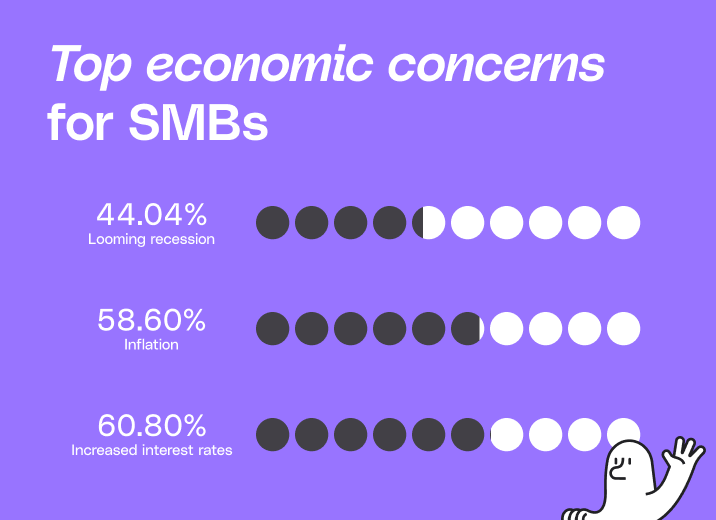
Small business owners are focused on interest rates, inflation, and a looming recession as their three main concerns, according to a recent survey conducted by OnePoll for Melio.
How can small and medium-sized businesses (SMBs) address these concerns? In this article, we’ll walk you through five strategies small business owners can use to set themselves up for success.
Clearing the fog: interest rates, inflation, and recession
Interest rates, inflation, and recession are the three economic forces most affecting small businesses today. Here is what each one means and how it hits your bottom line.
Interest rates
Interest rates, named a top concern by 61% of SMBs surveyed, represent the cost of borrowing money. When individuals or businesses borrow money, they incur interest expenses, paying a fee for the privilege of using someone else’s capital over a period of time.
Interest rates for loans can be fixed or variable. A fixed rate means that the interest rate remains the same for the duration of the loan, so the borrower knows exactly how much they’ll be paying each month. Typically, fixed interest loans come at a higher rate. Variable interest loans, on the other hand, typically have lower rates, but are subject to shifts according to a benchmark or index that changes with the economy.
Small businesses feel interest rate changes sharply because they often rely on loans. When rates rise, variable-rate repayments climb and strain cash flow.
Inflation
Inflation, cited by 59% of the SMBs surveyed, measures the general increase in the price of goods and services over time.
Essentially, it reflects the decline in the purchasing power of money. For example, if 10 T-shirts would cost you $100 in the beginning of 2003, those same 10 T-shirts would be about $175 by 2025, according to the U.S. Department of Labor’s inflation calculator.
While some levels of inflation are to be expected, it becomes a problem when there are sharp increases during periods of economic turmoil.
Inflation affects small businesses in many different ways, such as higher costs for utilities, equipment, goods, and products, rent increases for physical storefronts or storage facilities, and greater transportation costs. In addition, growth plans become less feasible, profit margins are lower, and consumer sentiment is low, with people avoiding unnecessary purchases.
Inflation also reaches small businesses through taxes. The IRS adjusts more than 60 tax provisions for inflation each year, including standard deductions and income thresholds, so your tax picture can shift even when your income does not (IRS).
Recession
A recession is an economy-wide decline in activity that lasts at least several months. It usually brings higher unemployment and lower output.
Many Americans, including 44% of the businesses we surveyed, have worried the economy is headed that way. Since then, sentiment has improved, with 93% of small businesses expecting growth in 2026 even as inflation and economic uncertainty stay top of mind. The good news? Some experts believe that the U.S. can continue to avoid a recession.
Five strategies to weather economic challenges
These five strategies help small businesses protect cash flow and keep growing through economic pressure. Work through them in order.
1. Raise prices
Increasing how much your business charges for goods or services may sound like the end of the world. However, it’s often the right business move.
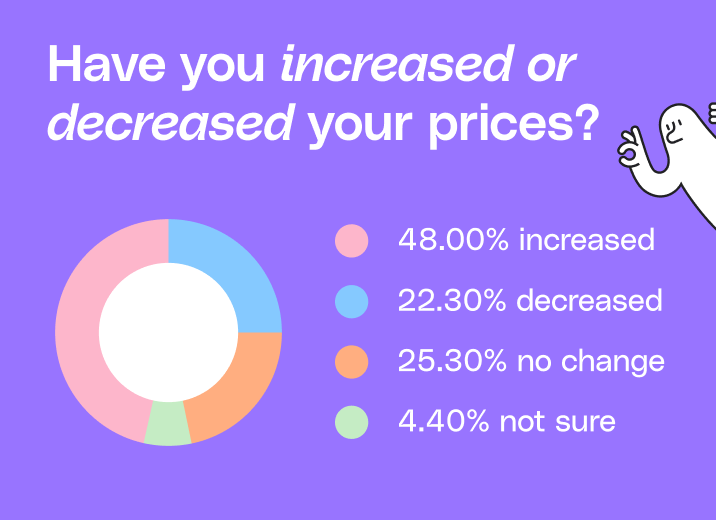
We have the data to back this up. Our survey found that nearly half (48%) of respondents raised their prices by an average of 7% over the last six months. A majority among that group reported increases in both repeat business (66%) and sales (63%). An increase in new clients was reported by 56% of the businesses that increased prices.
If you’re afraid customers will leave you due to the increase, we urge you to reconsider. It’s important to remember that, as a small business, the value you offer customers is unlikely to be the lowest price. Large companies will always have an advantage in that regard. Instead, customers likely choose your business for the personal touch, attention to detail, or flexibility you can offer. Additionally, in uncertain economic times, many of your competitors are likely raising their prices, too.
Consider creative ways to adapt your pricing. Perhaps you can switch to a monthly subscription pricing model or offer different price points for different tiers of services, such as a basic, middle, or premium package. You can also soften the blow of increasing prices by creating a loyalty program, such as a punch card. So, for example, for every 10 purchases over a certain amount, the customer gets a gift or a discount.
2. Expand your customer base
Getting more customers is a great way to shore up your business. Start by using your current contacts. Don’t be shy. Ask existing customers, friends, and vendors for referrals. Consider offering promotions or discounts on future orders as an incentive.
Additionally, don’t underestimate the power of face-to-face interactions. Attend trade shows, expos, and association events. Host a holiday party or partner with other local businesses to put on a community event to attract new potential customers.
You can also use online tools to expand your reach, like 58% of our survey respondents did. There are many free and paid marketing tools that can help. These include social media, search engine optimization (SEO) techniques, and traditional marketing methods that can connect you with a larger audience.
3. Reexamine your offering
Shifting your focus to the things that are bringing in the most profit is a smart business strategy. Nearly half (45%) of the companies surveyed reported that they reduced the production of various goods and services to address the changes in the economy.
Step one is to assess the profitability of your products and services. Do you have a product that’s been sitting on your shelves for months with little to no demand while another product is being snatched as soon as it arrives?
Once you’ve determined what sells and what doesn’t, reduce production or procurement of underperforming items and focus on what sells.
You can do a similar assessment when it comes to profit margins. Determine which products you are making more money on compared to their costs, and try to emphasize those. For example, you can put those products in a more prominent location in your store or feature them on your social media or the homepage of your website.
Consider specializing in one specific area instead of overreaching into wider offerings. You’ll spend less money on making sure you have something for everyone, and instead create a reputation as the go-to business for your chosen niche.
4. Start selling products online
It’s time to embrace e-commerce if you haven’t already. Selling products online is a way to reach customers outside of your geographic area and can significantly increase revenue. Online marketplaces like Shopify can help you easily build and operate an e-commerce store.
Adopt digital tools
Over 25% of small businesses are streamlining processes with technology to fight inflation, and this held true across every age group surveyed.
Respondents were particularly interested in digitizing bookkeeping and payments, with 53% of small business owners saying they would like to increase digitization in this field.
Three-quarters of small business owners believe that accepting forms of payments beyond cash is more important than it used to be. By accepting other forms of payment, you’re creating a more seamless shopping experience for your customers, whether they’re consumers or other businesses.
We’ve got just the thing. Online payment tools like Melio help you track payments, choose payment methods that fit your cash flow, and get paid faster, so more time goes back to running the business.
Looking to the future
By implementing these strategies, small businesses can not only survive economic uncertainties but also thrive in the face of adversity. As the business landscape shifts, adaptability and strategic decision-making will be key to long-term success.
Fortunately, there is reason to be optimistic. Despite the economic hardships of the past year, 76% of small business owners feel equipped for the future.
By being proactive and adapting to change, your small business can continue to flourish. Start today by signing up for Melio to digitize your business-to-business (B2B) payments.
Small business challenges FAQs
What is the biggest challenge for small businesses?
Cash flow is often the biggest challenge, followed closely by rising costs and inflation. Many owners struggle to cover expenses while waiting on customer payments.
What are the most common problems small businesses face?
The most common problems are limited cash flow, rising costs, higher interest rates, finding customers, and adopting the right technology.
How can small businesses overcome economic challenges?
Small businesses can adjust pricing, expand their customer base, focus on their most profitable offerings, sell online, and use digital payment tools to protect cash flow.
*This blog post is intended for informational purposes only and is not intended as financial advice.
**Melio does not provide legal, tax or accounting advice, and you should consult with a professional advisor before making any financial decisions.

Technology for Small Business: Why It's Worth the Upgrade
Learn how upgrading technology helped one small business owner rebuild and win back hours every week.

Cash Flow Problems: How to Diagnose and Fix the Causes
Learn how to diagnose the real causes of your clients’ cash flow problems and prescribe fixes that work.
7 Ways Melio Can Maximize Your Small Business Cash Flow
Discover seven practical ways to manage your small business cash flow and keep more cash on hand.