The 3 Financial Statements Every Business Owner Should Know
Learn how the three financial statements work together to reveal your business’s true health.


- Key takeaways
- What are the three financial statements?
- The importance of financial reports
- Difference between financial reports and financial statements
- Profit and loss (P&L) statement
- Balance sheet (BS)
- Statement of cash flow (SCF)
- How are the three financial statements linked?
- Quick tips for financial reporting
- Make financial reporting easier
- Financial statements FAQs
Key takeaways
- Track your profit and loss statement to see whether your revenue outpaces your expenses over time.
- Review your balance sheet to understand what your business owns and owes at any given moment.
- Compare your statement of cash flow against your profit to see how much cash you actually have available.
- Remember that profit isn’t the same as cash flow, so a profitable business can still run short on cash.
What are the three financial statements?
The three financial statements are the profit and loss statement, the balance sheet, and the statement of cash flow. The profit and loss statement shows your earnings and expenses. The balance sheet shows what you own and owe. The statement of cash flow shows money moving in and out. Together, they give you a full picture of your business’s finances.
- Profit and loss statement (P&L): This report summarizes your revenue, costs, and expenses over a set period. It tells you whether your business made a profit.
- Balance sheet: This report captures your assets, liabilities, and equity at a single point in time. It shows what your business is worth right now.
- Statement of cash flow: This report tracks the actual cash entering and leaving your business. It shows whether you can cover upcoming bills.
The importance of financial reports
Financial reports give stakeholders a clear view of your business’s financial health. They organize and present your financial status for both internal and external readers.
Here are a few key reasons financial reporting is so important:
- Financial visibility: Reports reveal the indicators of a business’s health, such as profit versus loss, cash flow, balance sheets, and more. Business owners use the reports to assess profitability, monitor cash flow, and track liabilities.
- Smarter decision-making: Financial reports help business owners make more informed decisions, such as how to effectively allocate resources, plan for growth, and address issues before they escalate.
- Attracting investors and securing loans: Financial reports demonstrate a business’s stability and potential, which is essential for working with investors and loan providers.
- Taxation and regulatory compliance: Financial reports are a key component in tax preparation. By tracking and recording the business’s activity, reports also help to ensure compliance with legal and financial regulations.
Difference between financial reports and financial statements
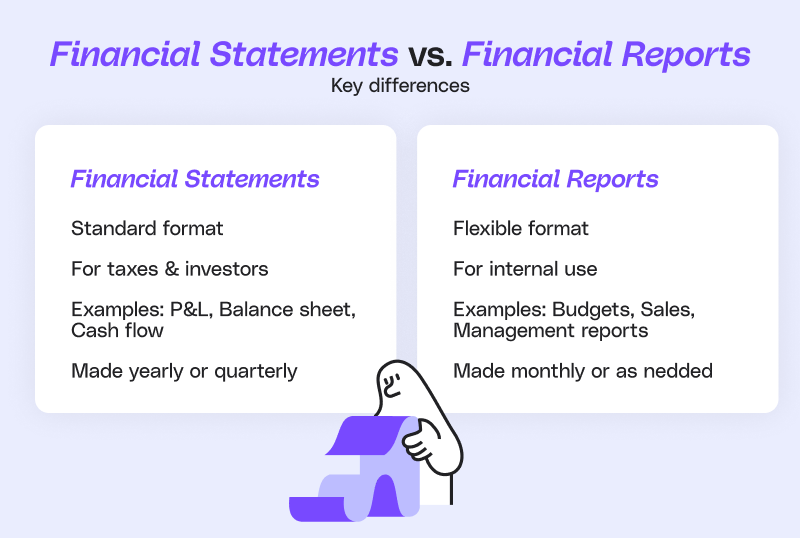
The terms “financial reports” and “financial statements” are often used interchangeably. However, there are some significant differences.
Financial statements are standardized documents that provide a formal overview of a business’s financial position. Examples include the balance sheet, income statement, and cash flow statement.
Financial statements typically provide a snapshot of financial health over a specific period. They’re used for compliance, tax preparation, and high-level financial analysis. Their primary readers are business owners, investors, financial institutions, and regulatory bodies.
On the other hand, financial reports encompass a broader range of documents. These can include financial statements, along with additional analyses and data summaries related to financial performance. They provide a more detailed and often customized view of the business’s financial situation.
Financial reports examples could be monthly management reports, budget analyses, and sales reports. Generally, financial reports are used internally by the business for performance tracking, strategic planning, decision making, and operational management.
Financial reporting is a complex arena. Businesses can use a wide variety of reports and statements to get clarity on their finances. What are the three financial statements that should not be overlooked according to Melio experts? Read on.
Profit and loss (P&L) statement
A profit and loss (P&L) statement shows your financial performance over a set period. It compares money coming in against money going out, covering revenue, expenses, and net income.
P&L accounts
Here are the key items in a P&L report:
- Income – revenue from sales and earnings
- Cost of goods (or services) sold (COGS or COSS) – the cost of products and services needed to directly generate sales
- Gross profit – income minus COGS or COSS
- Expenses – the cost of items and services that keep the business operational
- Other income and expenses – income and expenses that are not a core part of the business’s operations
“Income” refers to revenues generated from sales. It is also important to track the different types of sales. You may want to include sub-accounts under the “Income” header of your P&L report to paint a more thorough picture.
COGS or COSS, or “Cost of goods (or services) sold,” are the costs directly related to sales. They could be merchant fees, widgets purchased to manufacture products, or e-commerce platform fees. Any product or service tied directly to a sale counts.
For example, let’s say you’re an online retailer or service provider that is paid at the point of sale. Maybe your payment processor takes a percentage, or your sales platform charges a fee, and so your COGS or COSS is high. You don’t have a slow payment problem and you’re not “financing” your customers. But you still have high fees associated with your sales.
COGS or COSS explains how your sales are great, but the gross revenue is not. Understanding the costs associated directly with sales will help you plan ways to reduce those expenses. You might find a different sales platform or a new payment processor with better rates.
Moreover, expenses such as rent, payroll, software, and travel must be paid even if you don’t make a single sale.
Controlling your spending is important. But you can only make strategic decisions if you know how much money is coming in, how much you are spending, and where you are spending it. That spending supports marketing and sales or keeps business operations running smoothly.
Your P&L report may indicate that you have lots of revenue. But if your customers are slow to pay, the Accounts Receivable (AR) on your Balance Sheet (BS) will be high. The BS AR account tells you how much you are owed. The open, slow-paying, or overdue client invoice data that sits on your BS then tracks to the Statement of Cash Flows (SCF). More on that later. SCF reports explain why you have good sales but not enough available cash.
Balance sheet (BS)
The Balance Sheet (BS) is a snapshot of a business’s financial position at a given point in time: how much you own and how much you owe. The BS includes all the business’s assets, liabilities, and shareholder equity. It provides insight into a company’s liquidity, solvency, and financial stability at a specific moment.
BS accounts
Here are the key items in a Balance Sheet statement:
- Bank accounts and actual cash – the money that the business has
- Current assets – assets currently owned or likely to be realized within 12 months
- Inventory
- Accounts Receivable – how much the business is owed from customers
- Long-term assets – assets owned or assets that have long-term value
- Property, plant, and equipment
- Money owed that is not sales-related
- Equity – owner investment, preferred shares
- Short-term liabilities – what the business owes:
- Credit cards and short-term notes
- Accounts Payable (AP) – how much the business owes vendors
- Long-term liabilities – what the business owes over a longer time period (over 12 months)
- Retained earnings – money left over after paying all obligations and after paying out dividends
- Profit or loss – sales minus expenses over a period of time
Retained earnings shows your carry-forward income or loss. It signals whether you can take funds out as dividends, reinvest in research and development, or buy new equipment.
AP and AR flow from the P&L (invoices and bills) is key to determining whether you have overdue balances. It may tell you that you need to tighten up payment terms for customers and perhaps get better terms from vendors as well. This situation would be reflected on the Statement of Cash Flow (SCF): your cash is being paid out to vendors while you are holding customers’ balances.
The Equity and Current Assets numbers on the Balance Sheet will tell you if you and any other shareholders have put in or taken out too much money (personally or as partners), which can tie to the SCF.
As its name indicates, the Balance Sheet should always balance out: your assets should equal your liabilities and shareholder equity. If it doesn’t balance out, then there’s an error or miscalculation somewhere in your data, your inventory, or your calculations.
Statement of cash flow (SCF)
Statement of Cash Flow (SCF) shows how much money moves in and out of the business during a given period. It details the cash generated and used in the business’s operating, investing, and financing activities. Your SCF is important to increase your cash flow knowledge, understand your business’s operational efficiency, and understand its ability to meet its financial obligations or fund growth.
SCF accounts
Here are the key items in a Statement of Cash Flow:
- Operating cash flow – cash flow from core business operations
- Additions to cash: revenue
- Subtractions from cash: expenses
- Investing cash flow – activities from purchasing or selling assets
- Financing cash flow – activities from debt or equity financing
How are the three financial statements linked?
Profit and Loss (P&L), Balance Sheet (BS), and Statement of Cash Flows (SCF) are separate financial reports that offer insights into different aspects of a business’s financial health. However, they are also interconnected and affect one another.
For example, the P&L shows net income (or loss) over a period, which flows into the Balance Sheet as retained earnings under “owner’s equity.” Revenue and expenses recorded in the P&L affect the assets and liabilities on the Balance Sheet by either increasing assets or creating liabilities.
The Cash Flow Statement reflects changes in the Balance Sheet accounts. It shows where cash inflows and outflows come from by tracking changes in assets, liabilities, and equity. An increase in accounts receivable on the Balance Sheet, for example, reduces cash in the operating section, while an increase in loans payable adds to cash in the financing section.
Together, these three financial statements can provide a more comprehensive view of profitability, liquidity, and financial stability, enabling businesses to better understand and manage financial status.
Quick tips for financial reporting
Set up your statements so they’re easy to read and compare over time. These tips help:
- Number your chart of accounts (or have your accounting professional number it for you). Your accounts will be sorted into a more meaningful order.
- Use sub-accounts to break down your accounts into smaller accounts to track expenses with more detail. You will have the option of granularity, or you can collapse your reports for easy-to-view financials.
- Use comparative reports for the P&L and the BS and review them at least once per quarter. It is not enough to know where you stand this month or YTD. You must compare it to previous periods so you can track whether you are growing or shrinking your profits and your cash flow over time.
Make financial reporting easier
It’s easy to assume that a profitable business always has cash in the bank. That isn’t always true. You can show a healthy profit on paper and still struggle to pay your bills on time.
Reading all three statements together helps you spot these gaps early and plan ahead. When you’re ready to keep cash flowing smoothly, you can pay bills and send invoices in one place. Sign up for Melio to get started.
Financial statements FAQs
What are the main three financial statements?
The three main financial statements are the profit and loss statement, the balance sheet, and the statement of cash flow. Each one shows a different view of your business’s finances.
Are there three or four financial statements?
Most small businesses focus on three core statements. Some larger companies also prepare a statement of changes in equity, which brings the total to four.
Which financial statement is most important?
No single statement is most important, because each answers a different question. For many small business owners, the statement of cash flow feels the most urgent day to day.
How often should a small business prepare these statements?
Many small businesses prepare these statements monthly to stay on top of their finances. Reviewing them quarterly and yearly also helps you spot longer trends.
*The purpose of this page is solely to provide information and should not be considered as financial advice
**Melio does not provide legal, tax or accounting advice; you should consult a professional advisor before making any financial decisions.
Kellie Parks is the founder of Calmwaters Cloud Accounting Resources. She crafts processes and automation for future-thinking accounting professionals and business owners who believe in the mightiness of online technology. Certified, partnered, or affiliated with over a dozen cloud applications, she’s also a proud member of the Intuit International Trainer Writer Network and the FreshBooks Partner Council.

Outsourced vs In-House Bill Pay: Which Model Fits Your Family Office?
See how outsourced and in-house bill pay compare, so you can pick the right model for your family office.

How To Turn A Bad Customer Experience Into A Good One
Learn how to turn an unhappy customer into a loyal one and protect your business reputation.

What Is Incremental Cash Flow? Definition, Formula and Examples
Learn how incremental cash flow shows the true impact of a new project before you commit any money.