Your Payment Process Is Costing You Cash Flow. Here’s How To Fix It.
Turn every bill payment into a cash flow advantage with smarter timing, funding, and vendor flexibility.


Key takeaways
- Treat every payment as a cash flow decision, not just a task to automate.
- Control your payment timing to hold cash longer, capture early payment discounts, and avoid late fees.
- Fund payments with your business credit card to unlock idle credit and up to 45 days of float.
- Give vendors clear payment timing to strengthen relationships and win faster work.
What is cash flow management?
Cash flow management is the process of tracking and controlling the money moving in and out of your business so you always have enough cash on hand to cover what’s due. It’s about timing as much as totals. Even a profitable business can run short if cash goes out before it comes in.
For small businesses, one of the biggest levers is also the most overlooked. How and when you pay your bills has a direct effect on the cash you can actually use.
Every payment is a liquidity decision
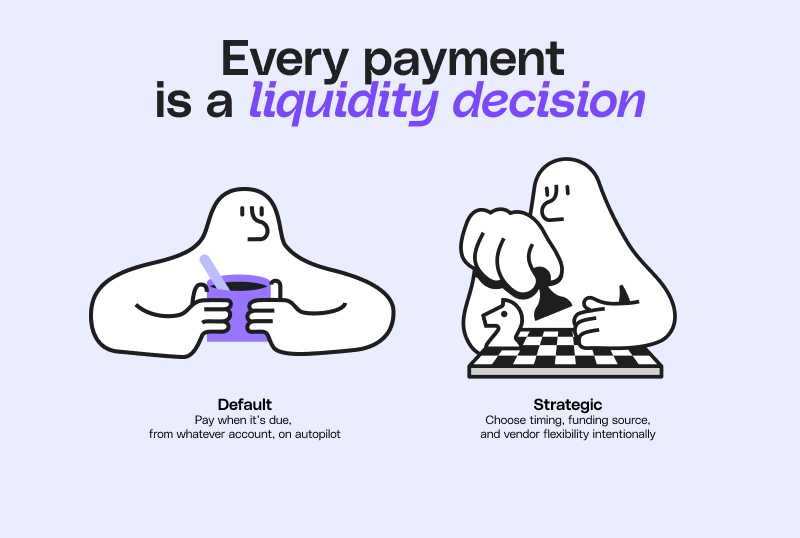 Businesses invest in automating AP because it makes sense. Less manual work, fewer errors, faster processing. That progress is real and worth having.
But there’s a difference between processing payments faster and being intentional about how that money moves. Almost nobody is addressing the second, and that’s what actually affects your cash position.
Most businesses only think about payment timing when they’re already in trouble. That’s exactly when it’s too late to use it strategically. Invoices go out on whatever schedule the business has always used, funded from whatever account has always been used. Nobody’s asking whether paying that invoice today versus in ten days makes a difference, or whether there’s a smarter way to fund it.
You can run a perfectly clean AP process and still leave real money on the table every month.
Consider a simple B2B example. You buy at $50 and sell at $100, so the margin looks healthy. But if your client takes six months to pay, you carry a six-month gap between money going out and coming in. If you can’t fund that gap, the margin on paper isn’t cash you can use.
Add to that: about 26% of B2B payments in the US are still made by paper check, according to the 2025 AFP Digital Payments Survey, and those checks can take several business days to clear. In a working month of roughly twenty days, that’s a significant window where capital is simply in transit after the work is done and the invoice sent. That money belongs to the business, it just isn’t available to it yet.
This is why automation isn’t enough. A faster process only gives you a faster, more efficient, version of what you already have.
For accountants managing AP on behalf of clients, this is also where the tool you use and recommend matters. A platform built purely around processing efficiency can’t give you control over those decisions. A platform built around payment strategy can. And that means a different kind of work.
What a smarter payment strategy actually looks like
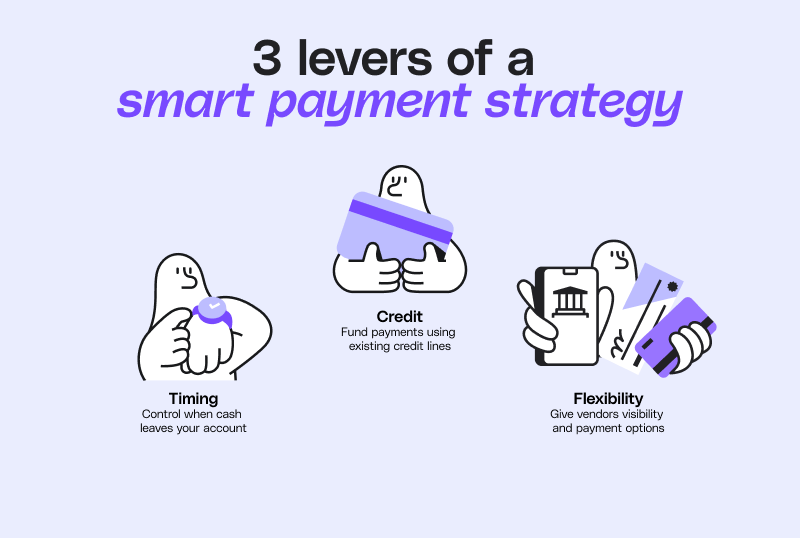
Once you start looking at accounts payable as a liquidity question rather than a process question, a different set of priorities comes into focus. The goal isn’t just to move payments efficiently, it’s to make those payments work in the business’s favor. Three decisions make that possible: when you pay, how you fund it, and what flexibility you give the people you pay.
Timing: when you pay
Timing is a decision. Most businesses just aren’t making it.
Invoices go out when they come due, on whatever rhythm the business has always used. But when funds leave your account is entirely within your control, and it’s usually the most accessible place to start.
Being in control of timing means:
- Hold cash longer when you need runway or want extra capital to invest in growth
- Take early payment discounts when the economics make sense
- Avoid late fees without scrambling at month end
- Align your outflows with the actual needs of the business rather than a default schedule.
Real-time payments have made this kind of precision possible. If you’re not in a position to negotiate better terms with a vendor, better control of your timing is usually the most accessible lever available to you.
Credit: how you fund it
Your business credit card may be one of the most underused cash flow levers you have.
You probably have tens of thousands of dollars in available credit sitting idle on your business credit card. The average US small business card limit is about $56,100, and higher-limit cards often run well beyond that. The reason is simple: most B2B vendors don’t accept card payments.
So that available credit stays unused while you look for capital elsewhere, scale back on investment, or simply operate with less flexibility than you need to. The capital exists. It’s just inaccessible in the default workflow.
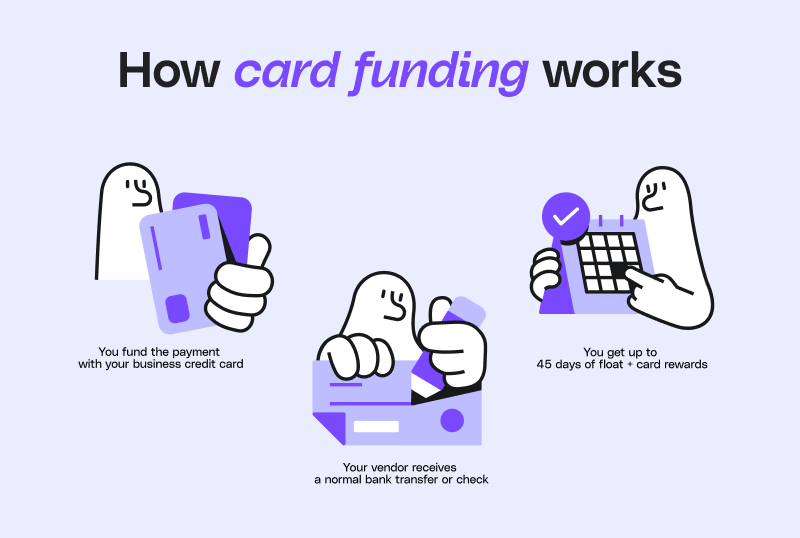
There are platforms now, like Melio, that unlock that liquidity. You fund a payment using your card and your vendor receives it as a normal bank transfer or paper check.
They get paid how they expect to be paid. You get access to your credit line and up to 45 days of float.
There’s a fee for doing this, typically around 2.9%, but once your card’s cash back is factored in, the real net cost is meaningfully lower, giving you access to your credit line for any business expense. And that doesn’t factor in additional value from reward points generated by the transactions (which can fund thousands of dollars in business or personal travel), or the interest collected from keeping that cash for an extra 45 days in a high-yield savings account or other investment vehicle. It doesn’t make sense for every transaction, but often we see users actually net out ROI positive.
The instinct is to see that fee and stop. But 2.9% against zero is the wrong comparison. The right question is what it costs you not to have that capital available.
Example: Let’s say you’re investing heavily in Google Ads, spend that you know pays back but over a 90-day cycle. Google no longer accepts card payments from certain high-spending advertisers. Without that working capital, you’re either pulling back on investment that makes sense or funding it from cash reserves you need elsewhere. The float closes that gap.
We’ve seen businesses such as wholesalers and construction companies use exactly this approach to grow dramatically, simply by unlocking capital that was already available to them.
Card funding doesn’t stop at domestic payments. Most businesses pay overseas vendors in dollars by default, because it’s the currency they operate in and because it’s often the only option their payment tool allows. The vendor then absorbs the conversion costs and deals with slower clearing times on their end.
Some platforms now let you fund an international payment in dollars, using your card, while the vendor receives it in their local currency. You don’t manage the conversion. You get your card float and rewards. They get paid faster and at lower cost. That’s a better outcome for both sides without either of you doing anything differently. Win win.
Flexibility: for the people you pay
A good payment strategy doesn’t just help your business, it makes you a better business to work with.
Giving vendors visibility over a scheduled payment, and a clear expected arrival date, means they can plan around it. If they need it sooner, they can choose to expedite at their own cost, while your schedule stays exactly as it is.
Contractors in particular often operate with very little cash reserve. If they’re not sure when a payment is coming, they’ll prioritize clients who give them certainty. Knowing when they’re getting paid, and having the option to receive it faster if they need to, can be the difference between them taking your next job or someone else’s.
This is mutually beneficial. For certain vendors, paying faster earns you early payment discounts and strengthens relationships you depend on. This is something Melio users tell us is an unexpected added benefit.
Rewriting the job description of the back office
The payments you’re already making, approached with more intention, can meaningfully improve your cash position. Here’s what you can do:
- Separate how you fund a payment from how your vendor receives it. These are two different decisions and treating them as one is where most of the missed opportunity lives.
- Give your vendors flexibility, but let the platform manage it. Creating optionality for the people you pay shouldn’t add work to your process.
- Bring automation and cash flow strategy into the same system. Automation without strategy scales your existing habits. The two together is where the transformational impact is.
For accountants and bookkeepers managing AP on behalf of clients, clean books and on-time payments are the baseline. There is untapped value in understanding that every decision about how and when a payment is funded has a direct impact on your client’s cash position, and acting on that. That’s the shift from taking AP off someone’s plate to helping their business keep more of what it earns, and unlock growth at scale.
Once you start treating those moments as decisions rather than defaults, accounts payable stops being a back office function, whether you’re a business owner, or an accountant or bookkeeper supporting small businesses. It becomes a working capital strategy.
Ready to make every payment work harder for your cash flow? Sign up for Melio and start turning your bill pay into a working capital strategy.
Cash flow management FAQs
What is cash flow management?
Cash flow management is tracking and controlling the money moving in and out of your business so you can cover what’s due and put spare cash to work.
What are the three types of cash flow?
The three types are operating, investing, and financing cash flow. Operating cash flow, from day-to-day business activity, is the one small businesses watch most closely.
How do you manage cash flow?
Forecast what’s coming in and going out, then use your payment decisions to your advantage. Control when you pay, choose how you fund each payment, and give vendors clear timing.
What are the five rules of cash flow?
A simple version: know your numbers, get paid faster, time your outflows, keep a cash reserve, and separate cash flow from profit. Cash on hand, not paper profit, keeps a business running.
*This blog post is intended for informational purposes only and is not intended as financial advice.
**Melio does not provide legal, tax or accounting advice, and you should consult with a professional advisor before making any financial decisions.

Virtual Terminal Credit Card: Small Business Processing Guide
Discover how a virtual terminal lets your business accept card payments by phone, email, or online.

ACH vs SWIFT: Key Differences for Business Payments
Learn when to use ACH or SWIFT so every vendor payment lands on time and on budget.

How using Melio helped me hack the recipe development process
Today’s technology lets recipe developers earn miles on business purchases. This means huge savings on traveling to the places that inspire their flavors.