8 ACH Benefits For Your Small Business
Discover how ACH payments cut costs, speed up cash flow, and protect your small business.


Key takeaways
- Schedule ACH payments to hold onto cash longer and keep your cash flow predictable.
- Cut costs by paying with ACH transfers, which run far less than checks, wires, or cards.
- Protect your business with a secure, Nacha-governed network that keeps bank details hidden.
- Automate recurring payments to avoid missed bills and reduce involuntary churn.
What is an ACH payment?
An ACH payment is an electronic bank-to-bank money transfer processed through the Automated Clearing House network. It lets businesses securely send and receive money, even between different banks. Types of ACH transfers include person-to-person payments (like Venmo), business bill payments, direct deposits from employers to employees, and government benefit programs.
Learn more about ACH payments in our complete guide to ACH.
ACH for small businesses: getting used to the idea
Many small businesses are still hesitant to adopt ACH as a form of payment to their vendors, much of it due to the feeling they aren’t safe.
But although it may seem surprising, ACH is actually far safer than checks. Checks and ACH use the same financial information to process payments (routing number, account number, and payment number). Any time a small business sends a paper check, the bank data that appears on the check can potentially be exposed to whoever comes in contact with it.
On the other hand, the ACH network has security protocols set up to allow businesses to join the network and transfer money between them without seeing each other’s bank details. In this way, sensitive banking data is always protected. There are additional control mechanisms available, such as ACH positive pay, adding more security layers to an already-safe payment method.
Bottom line, there is no reason for small businesses to fear ACH payments. In fact, they are safer than checks—and that is just the tip of the iceberg. The benefits of ACH go far deeper.
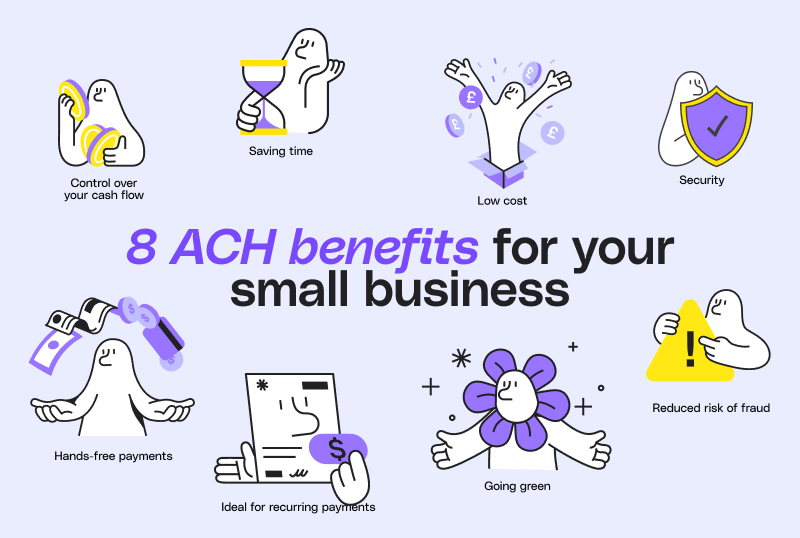
8 ACH benefits for your small business
ACH has benefits for small businesses—both vendors and customers. Let’s dive into the benefits of ACH payments, from cash flow to security and more:
1. Control over your cash flow
With ACH bank transfers, you can schedule payment dates, so your small business can make automatic payments on or very close to their due date. This allows you to hold on to your cash longer. It also helps eliminate the uncertainty of when a check will be deposited and funds withdrawn. Not to mention the extra time, cost, and penalties if a check gets delayed or lost in the mail.
When you send or receive a business payment via ACH, you don’t have to wonder when or if payment will arrive. The funds are forwarded directly and quickly from the customer’s bank account to the vendor’s.
2. Save time
ACH payments can be scheduled in advance. This allows businesses to spend less time writing, sending, and tracking checks. Additionally, vendor details only need to be registered once. After that, sending recurring payments is fast and easy. Overall, ACH is a much quicker and more efficient process, especially when using an easy payments platform like Melio.
3. Low cost
ACH is usually the cheapest way to move money. Here is how the common options compare:
- Business check: about $4 on average, and up to $20 once labor, materials, and postage are counted.
- Domestic wire transfer: typically $25 to $30.
- ACH transfer: usually $0.20 to $1.50 per transaction, with costs dropping further at higher volumes.
4. Security
ACH transactions are encrypted, and the system stores data without exposing it to the various parties involved. This is one of the most important ACH benefits for vendors as well as for businesses. Vendors can receive payments from businesses without having to worry about their bank details being seen by outsiders. And businesses can send payments without sharing their private bank details. Protecting yours and your vendors’ data should always be a priority, and ACH payments are designed to do just that.
5. Hands-free payments
Customers increasingly expect contactless, hands-free ways to pay. One of the ACH benefits for customers is that it provides this fast, convenient hands-free payment option, which many people today prefer and expect.
6. Ideal for recurring payments
If you need to make recurring payments (e.g. rent, lease, or a regular supplier), ACH payments can take care of routine transactions and make sure these payments are processed consistently and on time. ACH payments also allow you to receive recurring payments automatically, enabling you to better manage and predict your cash flow.
7. Going green
As a fully digital transaction, ACH payments eliminate the need for paper checks, envelopes, stamps, and of course, the carbon footprint required to transport and deliver checks. For companies who value sustainability and want to do their part to protect the environment, this is definitely another benefit of ACH.
8. Reduced risk of fraud
ACH lowers fraud risk. Because payments move electronically, there is no paper check to forge, lose, alter, or steal. ACH payments are governed by Nacha, the body that oversees the ACH network, and they add verification and authorization checks so only approved transactions go through. Using a payment platform like Melio reduces fraud risk even more, with added security measures on top of those in the ACH network.
Want to enjoy the benefits of ACH payments for your small business? Sign up for Melio today
When ACH makes the biggest difference for your business
ACH is not only cheaper and safer. It shines in a few common small business situations.
Multiple clients or vendors
If your business has only a handful of vendors, then making manual payments, whether by check, cash, or credit card, is probably not too much of a hassle. However, if your vendor list stretches a bit longer, your accounts payable process can become inefficient and harder to manage.
Say you run a discount clothing store. You need to maintain a broad selection of inventory, so you periodically buy from a few dozen suppliers. In this case, ACH makes a massive difference by saving you time and money on your payments operation. Paying each supplier separately is not only time-consuming. It’s also more prone to errors and missed payments.
On the receiving end of your business (that is, getting paid by clients), you aim to shorten the amount of time you wait for payment and give clients an effective, immediate way to pay you. The less time you wait, the better your cash flow. With automated accounts payable process and ACH bank transfers, you can track due payments more easily, and spend less time chasing your clients to pay you.
Clients or vendors across the U.S.
Businesses that operate locally—with clients and vendors nearby—can probably still rely on paying and getting paid with paper checks. But if the distance between your business, customers, and suppliers is larger than that, you should consider using ACH transfers.
When your clients and vendors (or both) are scattered across the country, using checks for payments increases the lag time from when the funds are sent to when they finally arrive. Then of course, you need to deposit the checks and wait for the money to clear into your account.
Every minute a check spends in the mail delays your cash flow. The lag also makes it harder to forecast when funds will clear, since there is always uncertainty about when checks arrive and how long they take to process.
On the other hand, distance within the U.S. won’t affect the ACH transfer speed. A transfer from Lewiston, Maine to Portland, Oregon takes the same amount of time as a transfer inside Lewiston itself.
Subscription-based payments
Businesses that rely on a subscription-based payment model are familiar with the problem of passive churn. That happens when an error occurs with recurring payments and the subscription is therefore canceled. This type of involuntary churn can happen for different reasons, such as an expired debit or credit card, or the card provider declining payment for some reason.
Setting up recurring ACH payments helps mitigate the risk of involuntary churn. ACH is directly linked to a bank account and doesn’t rely on card expiration dates, lost cards, or the card issuer’s decision to block payments. You have a high level of security knowing that your subscription payments keep coming in.
Moving your small business beyond paper checks
Despite the advantages of ACH payments, many small businesses are committed to vendors and suppliers who require payment in checks. Rent, utilities, insurance, and other business expenses often still gravitate towards paper.
Fortunately, smart online solutions like Melio can help small businesses manage payments efficiently and provide more freedom in vendor payment methods. Melio enables payment by ACH with a processing time of 3 days, and fast ACH for same-day payments. If your vendors insist on checks, Melio lets you pay by credit card or ACH transfer, while the vendor receives funds in their preferred form.
For businesses that want to take the leap and move away from checks towards digital payments and the ACH space, Melio is the solution for you.
ACH payments FAQs
Is there a downside to ACH payments?
ACH is not instant. Standard transfers take a few business days, so it is not the best fit when you need money to move within the hour.
Do banks charge fees for ACH transactions?
Often yes, but the fees are small. ACH usually costs less than a wire or card payment, and many providers include free transfers.
Is ACH safe?
Yes. ACH moves money through a secure network without exposing your bank details, and it adds verification and authorization checks.
How long does an ACH payment take?
A standard ACH transfer usually takes one to three business days. Same day options are available for a fee.
*This blog post is intended for informational purposes only and is not intended as financial advice.
**Melio does not provide legal, tax or accounting advice, and you should consult with a professional advisor before making any financial decisions.

Business Payment Terms Explained: Net 30, Net 60 and Beyond
Learn what payment terms net 30 means, how net 60 and net 90 compare, and understand how to pick terms that protect your cash flow.

Everything You’ve Ever Wanted To Know About Balance Sheets: Components, Formula, and Examples
Learn what a balance sheet is, what goes on it, and how to build one for your business.

How To Separate Your Business And Personal Finances
Protect your personal assets and simplify tax time by keeping business and personal finances apart.